Ancient China’s Hebrew Connection
Over 200 Compelling Correlations that Tie Ancient China to Ancient Israel
by Ryan Steed Parks
Book Excerpt:
Introduction
Did you know that the Chinese New Year (過年) began as the Hebrew Passover (逾越節)? Did you know that the red on the door posts and lintels of Chinese homes (now red banners) used to be the blood of the Passover Sacrifice? Did you know that Israelites1 (以色列人) settled in China shortly after the 10 Tribes were conquered and exiled by the Neo-Assyrians in year c. -721 (722 BCE)? Did you know that scattered Israelites also settled in Korea and Japan?
This work uncovers little-known evidence of a group of Israelites (בני ישראל) that settled in China in year c. -711 (712 BCE). The Hebrew Passover (פסח) New Year combined with the Feast of Unleavened Bread (חג המצות) holiday became part of Chinese culture, and today it is known as 過年 Guò Nián2• “The Chinese New Year.” This is why there are certain traditions associated with the holiday, including the red on door posts and lintels and the firecrackers set off at midnight. These actions were once intended to cause the Destroyer, 年 Nián,3• to 過 passover (過年 Guò Nián) the homes of Chinese families in order to spare their children. Anciently, the red on the Chinese homes was the blood of the Passover lamb (see Chapter 7).
The tradition was coined “The Chinese New Year” by foreigners who misinterpreted the observance and the Chinese character 年 Nián.3• The foreigners incorrectly assumed that the tradition was referring to the “passover” of the year, instead of the “passover” of the Destroyer. Over the centuries, the Chinese had forgotten the original meaning of the tradition and their Israelite heritage. The “Chinese New Year” has actually never taken place at the 過 “passover” of the 年 “year” on the traditional Chinese lunisolar calendar. Today, it takes place in the spring during the second month. This is because the holiday evolved from the Hebrew Passover and takes place at the time of the ancient Hebrew New Year, not the Chinese New Year.
How this all came to be is a fascinating story. It is a story supported by primary source evidence from both the Chinese (中國人) and the עברים Hebrews (希伯來人). This work includes and cites more than 1100 ancient primary sources! As you come to understand the larger historical picture, you will see the world in new and interesting ways. Things will make sense to you that didn’t before. This will be especially true if you are Asian or familiar with Asian culture and history. You will understand, in part, Asia’s Israelite heritage and that Hebrews played a much greater role in world history than was previously known.
You will also understand that the ancient belief systems of the Chinese and the Hebrews were remarkably similar during overlapping periods of time. Many of the differences were only linguistic, and actual beliefs and practices were the same or very similar. This was true before Israelites settled in China, Korea, and Japan. Not only did the ancient Hebrews and Chinese view and approach their head God in the same way, with the same beliefs, attitudes, and practices, including using the same names, but they also had a very similar complex system of animal, food, and drink sacrifices with which they worshiped Him. Many minute details were identical. And not only did they perform these sacrifices in the same ways, but they also did so for the same reasons. Their belief systems were very similar, sharing traditions, holidays, ceremonies, cultural heroes, and histories. And there is so much more!
1 The terms “Hebrew” and “Israelite” are used interchangeably in this work. Modern Judaism (猶太教) is somewhat distinct from the belief system of ancient ישראל Israel.
•2 Pronounced: gūō·nēĕn.
•3 Pronounced: nēĕn.
Some readers may see my compact, fact-packed, footnote-filled, and Hebrew and Chinese character strewn writing style as excessive. Please be patient with the format. Because the material is controversial, I felt like I had to be extremely thorough, especially for those whose culture and primary language is being examined. Feel free to skip over that which is not relevant to you.
The first matter that needs to be addressed is our traditional year numbering system. It is improperly missing the placeholder year zero. One year before the year 1 CE(AD) is the year 1 BCE(BC), instead of year 0. And 10 years before the year 5 is the year 6 BCE. This mathematical inconsistency causes confusion when studying events that span both the Common Era “CE” and Before the Common Era “BCE.” Astronomers have their own year numbering system that makes more sense. In Astronomical Year Numbering year 0 is properly included. CE years are displayed as positive numbers and BCE years are displayed as negative numbers. Instead of referring to a 10 year period with the years 6 BCE to 5 CE, that same 10 year period is referred to as years -5 › 5 “minus five to five.” Notice, because year 0 is included, the negative years in the astronomical system are one number less than those of the traditional system. I used Astronomical Year Numbering throughout this work. I believe it will become the dating standard in the future.
There were three primary belief systems in early China: Daoism “Taoism” (道教 Dàojiào4•), Buddhism (佛教 Fójiào5•) and an ancient belief system which does not have a widely accepted proper name. It is often mistermed 儒家 “Confucianism” or 儒學 “Ruism.”6• This belief system was already fully developed at the beginning of Chinese civilization and in its oldest written texts. Many of its beliefs and practices have continued until the present. This system existed at least 2200 years before Buddhism spread into China from India (around the year 100), and 1700 years before the birth of Daoism. Daoism began about the year -400 as a conglomerate of Chinese peasant superstitions, which transformed into a formal belief system about the time Buddhism came into China (c. 500 years later). Both Buddhism and Daoism adopted many beliefs and practices from the ancient Chinese belief system.
•4 Pronounced: däō·jēäō.
•5 Pronounced: fō·jēäō.
•6 Pronounced: rū·jēä, rū·shūā. 儒 rú means scholar.
儒家 “Confucianism” is the name most commonly given to the ancient belief system, but the name is incorrect. The system was already widespread at least 1600 years before 孔夫子 Confucius was born. He did not create the belief system or attempt to alter it; and he was very clear about that. Confucius insisted that he was “a transmitter and not a maker” of the precepts he put forth, “believing in and loving the ancients.”7 He spent his life championing a return to the ancient order. He argued that a restoration of that order would solve many of the problems his society faced.
“Ancestor Worship” is another descriptive term that often refers to the same ancient belief system. It is, however, inadequate and misleading. “Ancestor Worship,” more accurately termed “Ancestor Veneration,” is only a single facet of the much larger system. In this work, China’s traditional belief system will be termed “The Ancient Chinese Religion.” It primarily manifests itself in the worship of a head God called 上帝 Shàng Dì, 帝 Dì, or 天 Tiān, and the veneration of 神 spirits by the offering of animal, food, and other sacrifices.8•
7 James Legge, trans., Chinese Classics, 論語 Confucian Analects, book 7, Chapter 1 (Oxford: Oxford University Press, 1885): “述而不作, 信而好古.”
•8 Pronounced: shäng·dē, dē, tēĕn, shŭn.
The time period of focus for this work covers approximately 2,300 years. It is from the start of China’s first dynasty in the year c. -2071, to the end of the 漢 Hàn9• dynasty in year c. 220.10• The same general time period will be used when comparing the beliefs and practices among the Hebrews. As mentioned, over 1100 primary sources have been directly cited in this work; most were ancient texts. I used this approach to allow you to hear the ancient Chinese and ancient עברים Hebrews describe their belief system in their own words. I also used some source material from later time periods to gain a retroactive understanding of the past. For example, the imperial sacrifices of the last two dynasties (the years c. 1368 › 1911) will be reviewed because these sacrifices were intended to replicate the ancient sacrifices of China’s first three dynasties (the years c. -2071 › -226).
•9 Pronounced: hän. 漢朝 Hàn dynasty (c. -205 › 220).
•10 “c.” is an abbreviation of the Latin word “circa,” which means “close to.”
Confucius said: “Men all say: ‘We are wise.’”11 It is sometimes believed that scholars of today are more informed on ancient matters than the scholars that lived in ancient times. Scholars today are, indeed, more informed in many fields of study, but not in all fields, such as history. We do not see the past as clearly as the ancients did. It is wise for us to carefully study the writings of those that were closest to the historical events. They had the clearer perspective.
11 James Legge, trans., Sacred Books of East, volume 27-28, 禮記 The Book of Rites and Ceremonies, “中庸 The State of Equilibrium and Harmony,” section 1, paragraph 12 (Oxford: Oxford University Press, 1885): “人皆曰‘予知 .’”
This work relies almost exclusively upon the best primary source texts that are available for ancient China and Israel. It also relies upon the most widely-accepted English translations of those texts. This is important because many of the concepts covered in this work are controversial. Because of the use of the most reliable texts and translations, you can be confident that the words of the ancient writers are properly represented. Very few secondary sources were used. I have tried to present the quoted passages in their proper context and to fully reference them. This will help you find them in their larger works, if you so desire. I do hope to encourage and facilitate additional research on the topics covered in this work. The ancient Chinese texts most quoted in this work are: 五經 The Five Classics and 史記 Records of the Grand Historian. 五經 The Five Classics include: 易經 The Book of Changes,12• 書經 The Book of History,13• 詩經 The Book of Poetry,14• 禮記 The Book of Rites and Ceremonies,15• and the 春秋 Spring and Autumn Annals.16• These works are particularly useful because all, except the 春秋 Spring and Autumn Annals, are chiefly collections of ancient documents from the 周 Zhōu17• dynasty archives (c. -1046 › -479).
•12 Pronounced: ē·jēng. This was an ancient divination book for communicating with 神 spirits. Its current form was likely composed between the years c. -1000 › -900, but parts of the text stem from China’s first two dynasties covering the years c. -2071 › -1046. Confucius is credited with adding the three appendices.
•13 Pronounced: shū·jēng. This was a collection of historical documents composed by various authors between the years c. -2100 › -800.
•14 Pronounced: shŭr·jēng. This was a collection of 305 ancient poems compiled at the time of Confucius (c. -550 › -479).
•15 Pronounced: lē·jē. This was a work consisting of: 周禮 Rites of Zhōu, 儀禮 Book of Ritual from the western Zhōu dynasty (c. -1046 › -770), and two small commentary works attributed to Confucius and his disciples.
•16 Pronounced: tchūĕn·chēō. This was a commentary work of historical events events during the years c. -721 › -479 written by Confucius.
•17 Pronounced: jō. 周朝 Zhōu dynasty (c. -1046 › -770).
The authenticity and accuracy of 五經 The Five Classics is well established. Few ancient texts have been so carefully preserved and scrutinized. Chinese scholars have studied them for more than 2500 years. The famous 四書 Four Books (大學 Great Learning, 中庸 Doctrine of the Mean, 論語 Confucian Analects, and 孟子 Mencius) were chiefly written to expound the teachings of Confucius. Therefore, I consider them to be secondary sources, and they were used to a much lesser extent.
While Confucius and his disciples taught doctrines from The Ancient Chinese Religion, they admittedly did not fully comprehend it. They sought to improve their understanding by studying records found in the ancient 周 Zhōu dynasty archives. Confucius tried to restore The Ancient Chinese Religion, but openly acknowledged that he lacked enough information to do so. He lamented:
“Ah! Alas! I look at the ways of 周 Zhōu. (The Kings) Yōu and Lì corrupted them indeed, but if I leave [that which is improper], where shall I go (to find better)? The 郊祭 Border Sacrifice… is contrary to propriety. How have (the institutions of) the 周公 Duke of Zhōu fallen into decay!”18•
•18 Pronounced: jō, yōū, lē. 周朝 Zhōu dynasty (c. -1046 › -770). 禮記 The Book of Rites and Ceremonies, “禮運 Ceremonial Usages: Their Origins, Development, and Intention,” section 2, paragraph 1: “於呼哀哉! 我觀周道, 幽, 厲傷之, 吾舍魯何適矣! 魯之郊禘, 非禮也, 周公其衰矣!”
禮記 The Book of Rites and Ceremonies,which Confucius compiled from the 周 Zhōu dynasty archives, contains the following passage:
“That which is most important in performing the rites is to understand the meaning intended in it. If the meaning is lost, then the sacrifices are simply offered as a national celebration. Then subsequent generations will offer the sacrifice but not understand its meaning.”19
19 禮記 The Book of Rites and Ceremonies, “郊特牲 The Single Victim at the Border Sacrifices,” section 2, beginning of paragraph 3: “禮所之尊, 尊其義也, 失其義, 陳其數, 祝史之事也. 故其數可陳也. 其義難知也, 知其義而敬守之, 天子之所以治天下也.”
At the time of Confucius, the full meaning behind the sacrifices was no longer understood. When he was asked directly about the meaning of the Great Sacrifice, he replied:
“I do not know. If anyone knew the meaning of the Great Sacrifice, he would find it as easy to govern the empire as to look at the palm of his hand!”20
20 Sīmǎ Qiān, trans. Burton Watson, 史記 Records of the Grand Historian: Hàn Dynasty II (Revised Edition) 史記-後漢書, 10: “不知也. 知其說者之於天下也, 其如示諸斯乎! 指其掌.”
Although Confucius openly acknowledged that he did not fully understand all the aspects of The Ancient Chinese Religion, he still promoted it and was strict about performing its rites. In response to someone who “wished to do away with the offering of a sheep connected with the inauguration of the first day of each month.” Confucius replied: “You love the sheep, I love the ceremony.”21
21 論語 Confucian Analects, book 3 八佾, Chapter 17, paragraphs 1-2: “爾愛其羊, 我愛其禮.”
My intent in this work is to present The Ancient Chinese Religion in the purest form possible. I will bypass most commentary on it from others, including Confucius, and spend most of our time in the oldest, most reliable primary sources available. I will, as best I can, lay before you the primary sources that Confucius and his disciples used to understand The Ancient Chinese Religion.
There were many written records in the region that became China, but most of them did not survive the destructive reign of 秦始皇 Qín Shǐ Huáng22• (c. -226 › -209). He is called “China’s first emperor” because he conquered many kingdoms through his military campaigns until he successfully subdued much of the region known as China today. Emperor 秦 Qín23• engaged in extravagant and costly building projects, including starting construction on the Great Wall of China and building a city-size underground tomb complex for himself. The famous “Terracotta Warriors” surround his burial chamber in that complex today.
•22 Pronounced: chēn·shŭr·hūäng. 秦始皇 Qín Shǐ Huáng (c. -258 › -209).
•23 Pronounced: chēn.
In an attempt to control information and prevent the regime of Emperor 秦 Qín from being compared to benevolent rulers before him, 李斯 Lǐ Sī,24• one of the Emperor’s chief advisors, proposed that all literature that presented ideas incongruent with 秦 Qín’s totalitarianism, as well as all other historical records, be burned. 李斯 Lǐ Sī presented the following to the Emperor:
“I, your servant, propose that all historians’ records other than those of [the State of] 秦 Qín be burned. Except the academics whose duty includes possessing books [in the State archives], if anyone under heaven has copies of 詩經 The Book of Poetry, 書經 The Book of History, or the writings of the hundred schools of philosophy, they shall deliver them (the books) to the governor or the commandant for burning. Anyone who dares to discuss 詩經 The Book of Poetry or 書經 The Book of History shall be publicly executed. Anyone who uses history to criticize the present shall have his family executed. Any official who sees violations but fails to report them is equally guilty. Anyone who has failed to burn the books after thirty days of this announcement shall be subjected to tattooing and be sent to build the Great Wall. The books that have exemption are those on medicine, divination, agriculture, and forestry. Those who have interest in laws shall instead study from [the current] officials.”25•
•24 Pronounced: lē·sŭ.
•25 Pronounced: chēn. 秦朝 Qín dynasty (c. -226 › -206). 司馬遷 Sīmǎ Qiān, 史記 Records of the Grand Historian: Qín Dynasty, Chapter 6, “The Basic Annals of the First Emperor of Qín,” Year 34 (-212).
Emperor秦 Qín welcomed the proposal and made it law. His edict was carried out in year c. -212, and almost all of China’s ancient texts were destroyed. Only one of the Classics was exempted, the 易經 The Book of Changes,because it was used for divination. The following year, Emperor秦 Qín also had more than 460 scholars, loyal to Confucian thought, executed. The book burning continued for three more years. Copies of some outlawed texts were kept in the Imperial Archives for reference. But in the year c. -206, rebel forces overthrew the 秦 Qín government and burned the imperial palace and archives as well. In this devastating ruin, all remaining texts were destroyed.
This great tragedy haunts China to this day. Much of the written knowledge and wisdom of 2000 years of civilization was lost. And understanding the history of China before this cultural tragedy is now difficult. Fortunately, copies of some of the Classics and other useful books were later recovered from distant areas and hidden locations. In great acts of heroism, some scholars risked their lives by hiding books.
However, many famous and notable works were never recovered. For example, a surviving copy of the renowned Book of Music, the sixth major work in the Classics, has never been found. 五經 The Five Classics that did survive are now priceless treasures for understanding China before this cultural tragedy.
Some modern scholars have expressed skepticism about the reliability of 五經 The Five Classics. These scholars have suggested that Confucius, who was instrumental in their compilation, altered them to fit his worldview. This, however, is improbable for many reasons. One reason is that there were many other scholars at the time of Confucius who also frequented the 周 Zhōu dynasty archives. They would have certainly been familiar with the original texts he compiled into 五經 The Five Classics. If Confucius had altered the texts, his actions would have most likely been discovered and exposed at that time.
Another reason that it is improbable is because such actions would not have been congruent with his well-established reputation among his peers. He was well known for his integrity, thoroughness, and cautious scholarly approach. He earned his reputation by his works. Further, Confucius did not claim the philosophies he espoused to be his own. As previously explained, Confucius was open about being “a transmitter and not a maker” of the precepts he taught, “believing in and loving the ancients.”26 His self-proclaimed mission was to restore the ancient order, not to make a new one.
26 論語 Confucian Analects, book 7, Chapter 1: “述而不作, 信而好古.”
New archeological evidence has also demonstrated the reliability of 五經 The Five Classics. The relatively recent discovery of the 甲骨 “Oracle Bones” jiá gǔ,27• which are thousands of ancient bone fragments etched with script, verify much of the information and history contained in the Classics. All 30 商 Shāng28• dynasty Kings (as found in 五經 The Five Classics) as well as 14 generations of their ancestors have been verified by 甲骨 Oracle Bone inscriptions.29
•27 Pronounced: jēä·gū.
•28 Pronounced: shäng. 商朝 Shāng dynasty (c. -1638 › -1046).
29 Pei-Jung Fu, “On Religious Ideas of the Pre-Chou China,” Chinese Culture: A Quarterly Review, volume 26, number 3 (September, 1985): 23-39.
Other ancient texts have also been recovered that quote the same documents found in the Classics. These outside texts not only help prove that Confucius transmitted the texts accurately, but also show that 五經 The Five Classics have been transmitted into the modern era with amazing accuracy.30 五經 The Five Classics are undoubtedly one of the greatest resources we have for understanding early China. Written works composed shortly after The Great Book Burning are also especially helpful. These writers still had access to the memories and oral traditions of those who knew China before the cultural tragedy. They would have been able to reconstruct some of the earlier history. 司馬遷 Sīmǎ Qiān31•* (c. -144 › -85) was a particularly capable historian that lived less than a century after The Great Book Burning. He is known for his careful and objective approach to writing history. His highly respected work, 史記 Shǐ jì32• Records of the Grand Historian, is another very valuable resource and was quoted many times in this work.
30 K. C. Wu, The Chinese Heritage (New York: Crown Publishers, Inc., 1982), 450-467.
•31 Pronounced: sŭ·mä·chēĕn.
•32 Pronounced: shŭr·jē.
To help with Mandarin pronunciation, I have included in this work the Chinese tones for many Romanized Chinese words and names, such as Sīmǎ Qiān. The lines above the letters, such as the ī, ǎ, and ā in Sīmǎ Qiān, designate the Chinese tone for each respective syllable. They are not English pronunciation marks. For English pronunciation guides, follow footnote numbers that end with a dot (1•). There are also pronunciation guides for many terms in the Glossary at the end of this work.
Dr. James Legge’s33• English translations of the Chinese Classics are highly respected among scholars, and are widely considered to be among the best ever made. Dr. Legge studied in China for more than 30 years during its last dynasty, the 清 Qīng.34• He completed the translations after 50 years of work, and then died in 1897. China’s last dynasty fell only 14 years later in 1911.
•33 Dr. James Legge (1815-1897).
•34 Pronounced: chēng.
No other translators enjoyed the depth of resources available to Dr. Legge from his living under the last dynasty for so many years. Those resources included three of his capable Chinese assistants: 王韜 Wáng Tāo,32• 洪仁玕 Hóng Réngān,33• and 黄胜 Huáng Shèng.34• With their assistance, and a tireless work ethic, Dr. Legge was extraordinarily successful at the difficult task of translating the ancient Chinese texts into modern English. According to those who knew him:
“Legge was in his study every morning at three o’clock, winter and summer, having retired to bed at ten… he worked away at his translations while all the household slept.”35
•32 Pronounced: wäng·täō. 王韜 Wáng Tāo (1828-1897).
•33 Pronounced: hōng·rĕn·gän. 洪仁玕 Hóng Réngān (1822-1864).
•34 Pronounced: hūäng·shĕng. 黄胜 Huáng Shèng (1827-1902).
35 Jean Delisle, Judith Woodsworth, ed. (2012). Translators Through History, p. 180.
The translations of Dr. Legge have been used in this work. Older English words, spelling, phraseology, and punctuation are modernized. Outdated Chinese Romanization systems are replaced with Pinyin, the Mandarin Romanization standard of today. No other alterations have been made to his original translations. The parentheses used are as contained in Dr. Legge’s translation.
The Hebrew source texts used in this work are chiefly found in the Hebrew Bible, תַּנַ״ךְ Tanakh, or Old Testament (舊約). The individual texts were written about the same time period as 五經 The Five Chinese Classics and later compiled into the Hebrew “Bible” (which means “library”). They have also been well preserved, as has been validated by cross-examination with outside sources such as the Dead Sea Scrolls (死海古卷). The Hebrew Bible is the most widely distributed text in the history of the world. It has been translated into virtually every language.
Of the English translations of the Hebrew Bible, the most revered and widely accepted is the King James Version. This translation was commissioned by the British King James in 1604 and published in 1611. The King James Version is the translation that will be used in this work.
The focus of this work is the shared beliefs and practices connecting the ancient Chinese and Hebrew civilizations. This work is not intended to provide a comprehensive view of the ancient Chinese or Hebrew culture. That would be far too impractical and voluminous. In this work, ancient Chinese culture will be illustrated chiefly with passages from primary source texts. Highlighted principles will be followed by an underlined footnote number (1). The corresponding footnote will have the highlighted principle restated followed by an ancient Hebrew passage illustrating the same belief or practice. At the end of the chapter, the highlighted principles will be listed again. And the subsequent chapter will revisit each principle with additional Hebrew quotes and information to further establish the shared principle.
There may be principles with which you are already familiar. You may choose to skip over them. Spend your time on those concepts with which you are less familiar. However, it is important to read this book sequentially, as it builds upon itself. You may not fully appreciate the significance of later concepts without understanding important material covered earlier.
I have tried to be concise in writing. I have shared many profound concepts, sometimes in only one sentence. Be sure to ponder the significance of a statement before moving on. It will likely not be revisited.
Chapter 1
The Chinese God 上帝 Shang Di (天 Tian)
In “The Ancient Chinese Religion” (as defined in the Introduction) there were 神 spirits that presided over the celestial bodies, earth, locations, mountains, rivers, time periods, and so on. The deceased ancestors of the Chinese were also 神 spirits. These 神 spirits were in human form, had dominions and responsibilities, and were venerated by the living.
The Ancient Chinese Religion encompassed many 神 spirits; however, there was a universal God that ruled over all the 神 spirits, all forms of life, the earth, celestial bodies, and everything else.36 That God was 上帝 Shàng Dì37• (also called 天 Tiān38•). Hewas the creator of all things, all powerful, and the Supreme Ruler of the universe. Everything was subject to him. He is found in China’s most ancient texts and is presently still regarded by many Chinese as their God.
36 (1) He was their head God.
Hebrews: “…יהוה Yahweh is greater than all gods:” The Holy Bible, King James Version, Exodus 18:11. (In the Hebrew passages, the substitute term “Lord” (in small caps) will be returned to יהוה Yahweh in accordance with the original Hebrew texts. Reasoning for this adjustment will be further explained in Chapter 2.)
•37 Pronounced: shäng·dē.
•38 Pronounced: tēĕn.
五經 The Five Chinese Classics and the 商 Shāng39• dynasty 甲骨 Oracle Bones (created c. -1638 › -1046) both show the peoples’ belief that 上帝 Shàng Dì governed nature, weather, fortune, the outcome of wars, ruling authority, and so forth. The very nature of his name, in Chinese, reveals His supremacy. 上 Shàng40• means “above,” “supreme,” or “highest.” And 帝 Dì,41• anciently, signified “God.” English translations of 上帝 Shàng Dì include “God,” “Almighty God,” “Lord on High,” and “Most High God.”
•39 Pronounced: shäng. 商朝 Shāng dynasty (c. -1638 › -1046).
•40 Pronounced: shäng.
•41 Pronounced: dē.
Throughout their written history, the Chinese were clear and consistent about the existence of 上帝 Shàng Dì and his supreme nature. Dr. William Medhurst, a leading sinologist and linguist during China’s last dynasty, wrote:
“In no case do we find 上帝 Shàng Dì exhibited under any figurative representations… the Supreme Ruler is declared, again, again, and again to be distinct from the visible heavens. The main idea attached to 上帝 Shàng Dì is universal supremacy, uncontrollable power, justice, glory, majesty, and dominion.”42•
•42 Pronounced: shäng·dē. W. H. Medhurst, A Dissertation on the Theology of the Chinese with a View to the Elucidation of the Most Appropriate Term for Expressing The Deity in the Chinese Language. (Shanghai: The Mission Press, 1874), 273-274.
The esteemed Dr. James Legge wrote:
“But the Chinese stand out distinctly…in these two points: that their representations of 上帝 Shàng Dì are consistent throughout [history], and that they never raise any other being to an approximation to Him. He is always the same Creator and Sovereign Ruler, holy and just and good. And no other is ever made ‘equal or second’ to Him. He has no rival.”43•
•43 Pronounced: shäng·dē. James Legge, The Notions of the Chinese Concerning God and Spirits (Hong Kong: Hong Kong Register, 1852), 33.
The consistency in which the ancient (and modern) Chinese viewed 上帝 Shàng Dì (天 Tiān44•) as the ruler of all things makes The Ancient Chinese Religion monotheistic. When the belief system is properly understood, the difference between 上帝 Shàng Dì and the 神 spirits becomes clear. A variety of 神 spirits were venerated, but all of them were the subjects of 上帝 Shàng Dì.No 神 spirit ever approximated the status of 上帝 Shàng Dì.
•44 Pronounced: tēĕn.
The 神 spirits (including deceased ancestors) were venerated and prayed to with the hope that they would influence 上帝 Shàng Dì on behalf of the living. In the modern era, the character for spirit, 神 shén,45• has often been translated “god.” But throughout China’s history, the authority of the 神 Spirits was a little lower than that of the ruling emperor. 神 Spirits were not “gods” in the traditional sense. They had influence but, like mortals, they were also the emperor’s subjects. The emperor was traditionally called the 天子 “Son of 天 God.” He was the earthly representative and subject of 上帝 Shàng Dì (天 Tiān).
•45 Pronounced: shŭn.
The Chinese believed their God was anthropomorphic.46 He shared human-like form and characteristics. He was said to see, hear, speak, smell, and travel in a chariot. He shared human-like emotions. This topic will be further addressed shortly.
46 (2) He was anthropomorphic.
Hebrews: “God created [humankind] in his own image, in the image of God created he him;” Genesis 1:27.
帝 Di, 上帝 Shang Di, 天 Tian, 上天 Shang Tian, …
To correctly interpret the ancient Chinese texts, it is important to understand that the ancient Chinese had two written characters for their supreme God. One was 帝 Dì,47• the main character in 上帝 Shàng Dì,48•and the other was 天 Tiān.49• Both characters signified “God,” but 帝 Dì was a formal reference to God and 天 Tiān a less direct, informal reference. Characters also have multiple meanings and 天 Tiān also meant the “sky” above or “heavens.” The modern meanings and usages of these characters are not the same as they were anciently.
•47 Pronounced: dē.
•48 Pronounced: shäng·dē.
•49 Pronounced: tēĕn.
帝 Dì, 上帝 Shàng Dì, and 天 Tiān were used interchangeably in ancient China. In the following example, the 周公 Duke of Zhōu50• first refers to God by the term 天 Tiān, and then by the term 上帝 Shàng Dì, in the same passage:
“The 周公 Duke of Zhōu spoke to the following effect: ‘Prince Shì, 天 Tiān, without pity, sent down ruin on [the 商 Shāng dynasty]’…The Duke said: ‘Prince Shì, before when 上帝 Shàng Dì was inflicting calamity…’”51•
•50 Pronounced: jō. 周朝 Zhōu dynasty (c. -1046 › -770).
•51 Pronounced: jō, shŭr, tēĕn, shäng, shäng·dē. 周朝 Zhōu dynasty (c. -1046 › -770). 商朝 Shāng dynasty (c. -1638 › -1046). 書經 The Book of History, “周書 Books of Zhōu,” 君奭 Prince Shì, paragraphs 1, 4; underlining added: “周公若曰: “君奭! 弗吊天降喪於殷” …公曰: “君奭! 在昔上帝割…”
The scholar, 鄭玄 Zhèng Xuán52• (c. 127 › 200), wrote about the interchangeability of 上帝 Shàng Dì and天 Tiān:
“上帝 Shàng Dì is another name for 天 Tiān. The 神 spirits do not have two Lords.”53•
•52 Pronounced: jŭng·shūĕn. 鄭玄 Zhèng Xuán (c. 127 › 200).
•53 Pronounced: shäng·dē, tēĕn. Sīmǎ Qiān, 史記 Records of the Grand Historian, volume 28, Book 6, p. 624: “上帝者, 天之別名也. 神無二主.”
The 清 Qīng54• dynasty emperor, 康熙 Kāngxī,55• who ruled from c. 1661 › 1722, affirmed the same:
“And when sacrifices were offered to 天 Tiān it was not the blue existent sky that was addressed, but the Lord and Creator of all things. If the Ruler 上帝 Shàng Dì was sometimes called 天 Tiān …that had no more significance than giving honorific names to the emperor.”56•
“At the Border Sacrifices, the sacrifice is assuredly not addressed to the material and sensible heaven, which our eyes see, but to the Master of heaven, earth, and all things. Only out of reverence and respect…we sometimes do not dare to call Him by His true name [上帝 Shàng Dì].”57•
•54 Pronounced: chēng.
•55 Pronounced: käng·shē.
•56 Pronounced: tēĕn, shäng·dē. Jonathan D. Spence, Emperor of China: Self-Portrait of K’ang-hsi (New York: Random House, Inc. 1988), 79: “在祭天的時候, 對象不是藍天, 而是創造萬物的主. 如果上帝有時被稱為天, 那就好比有時給皇帝另一個尊稱而已.” underlining added.
•57 Pronounced: tēĕn, shäng·dē. Legge, The Notions of the Chinese Concerning God and Spirits (1852), 38: “古代帝王行祭天之禮即學者之郊社之禮乃是敬事上帝之意, 並非祭祀肉眼看到的有形有狀之上天也呼其名, 而是祭祀 天地萬物之主宰也不敢直.” underlining added.
Today, some less-informed scholars still create confusion by separating 上帝 Shàng Dì, 帝 Dì, and 天 Tiān. But the ancient Chinese texts are consistent regarding these interchangeable terms for their one God. Here are a few passages which display the interchangeability in the same sentence, paragraph, and thought sequence:
“上帝 Shàng Dì…sent down corrections, indicating His mind to him. (Jié) [(the 夏 Xià dynasty ruler)], however, would not be warned by 帝 Dì, but proceeded to greater sinfulness and sloth and excuses for himself. Then 天 Tiān no longer regarded nor heard him, but revoked His great appointment, and inflicted extreme punishment… Greatly abandoned to dissolute idleness, [Jié] gave no thought to the bright principles of 天 Tiān, and the suffering of the people. On this account 上帝 Shàng Dì no longer protected him, but sent down the great ruin which we have witnessed. 天 Tiān was not with him, because he did not make his virtue illustrious.”58•
“It is not I… who dares to undertake a rebellious enterprise; but for the many crimes of the King of 夏 Xià, 天 Tiān has given the charge to destroy him… as I fear 上帝 Shàng Dì, I dare not but punish him.”59•
“They presented their offerings to [Shàng] Dì at the border and announced to 天 Tiān…”60•
“上帝 Shàng Dì has reversed (His usual course of procedure) and the lower people are full of distress… 天 Tiān is now sending down calamities.”61•
“We…rightly disposed of the appointment of [the 商 Shāng Ruler], and finished (the work of) 帝 Dì. Now, you numerous officers, it was not our small State that dared to aim at the appointment belonging to [the 商 Shāng Ruler]. But 天 Tiān was not with [the 商 Shāng dynasty], for indeed [He] would not aid its misrule. [He] (therefore) helped us. Did we dare to seek the throne of ourselves? 帝 Dì was not for [the 商 Shāng dynasty], as appeared from the mind and conduct of our common people, in which there is the brilliant dreadfulness of 天 Tiān.”62•
•58 Pronounced: shäng·dē, jēŭ, shēä, tēĕn. 夏朝 Xià dynasty (c. -2071 › -1638). 書經 The Book of History, “周書 Books of Zhōu,” 多士 Numerous Officers, paragraph 2: “則惟[上帝]降格, 向於時夏. 弗克庸帝, 大淫泆有辭. 惟時天罔念聞, 厥惟廢元命, 降致罰…誕淫厥泆, 罔顧於天顯民祗, 惟時上帝不保, 降若茲大喪. 惟天不畀不明厥德” underlining added.
•59 Pronounced: shēä, tēĕn, shäng·dē. 夏朝 Xià dynasty (c. -2071 › -1638). James Legge, trans., Sacred Books of the East, volume 3, 書經 The Book of History, “商書 Books of Shāng,” 湯誓 Address of Tāng, paragraph 2 (Oxford: Oxford University Press, 1879): “非台小子, 敢行稱亂, 有夏多罪, 天命殛之…子畏上帝, 不敢不正.” underlining added.
•60 Pronounced: shäng·dē, tēĕn. 禮記 The Book of Rites and Ceremonies, “禮器 Rites in the Formation of Character,” section 2, paragraph 12: “饗帝於郊, 升中於天” underlining added.
•61 Pronounced: shäng·dē, tēĕn. 詩經 The Book of Poetry, “大雅 Major Odes,” 生民之什 Decade of Shēng mín, 板 Ban, paragraph 1-2: “上帝板板, 下民卒癉…天之方難” underlining added.
•62 Pronounced: shäng, shäng·dē, tēĕn. 商朝 Shāng dynasty (c. -1638 › -1046). 書經 The Book of History, “周書 Books of Zhōu,” 多士 Many Officers, paragraph 1: “敕殷命終於帝. 肆爾多士! 非我小國敢弋殷命. 惟天不畀允罔固亂, 弼我, 我其敢求位? 惟帝不畀, 惟我下民秉為, 惟天明畏.” underlining added.
The interchangeability of 帝 Dì, 上帝 Shàng Dì, and 天 Tiān is also affirmed by the archeological record. Two bronze vessels from the early 周 Zhōu63• dynasty (c. -1046 › -770) recorded:
“The Great 天 Tiān has found no displeasure but watches over and protects us.”
“The Great 上帝 Shàng Dì has found no displeasure but watches over and protects us.”64•
•63 Pronounced: jō.
•64 Pronounced: tēĕn, shäng·dē. Kunio Shima, A Study of Oracle Letters from the Ruins of Yin’s Capital, (Tokyo: Chiugokukai kenkiuhai, 1959), 217; as quoted in: “The Notions of God in the Ancient Chinese Religion,” by Joseph Shih, Numen 16, issue 2 (September, 1969), 100; underlining added.
Some scholars have incorrectly assumed that 上帝 Shàng Dì was the 商 Shāng65• dynasty God and 天 Tiān was the 周 Zhōu66• dynasty God. However, the archeological record, ancient texts, and 甲骨 jiá gǔ67• “Oracle Bones” show that 帝 Dì, 上帝 Shàng Dì, and 天 Tiān were used interchangeably during all of the early dynasties. The volume of evidence is overwhelming. It is unfortunate that this concept is still often misunderstood today. Many English texts improperly translate 天 Tiān as “heaven” when the intended reference by a Chinese author was to their God.
•65 Pronounced: shäng. 商朝 Shāng dynasty (c. -1638 › -1046).
•66 Pronounced: jō. 周朝 Zhōu dynasty (c. -1046 › -770).
•67 Pronounced: jēä·gū.
Other terms that the Chinese used to refer to 上帝 Shàng Dì (天 Tiān)include: 天帝 Tiān Dì “God,” 天神 Tiān shén “God of the spirits,” 太帝 Tài Dì “Great God,” 老天爺 Lǎo Tiān Yé “Heavenly Father,” 皇天 Huáng Tiān “Lord God,” 天王 Tiān wáng “God King,” 旻天 Mín Tiān “Compassionate God,” 天尊 Tiān zūn “Honorable God,” and, in modern times, 天主 Tiān zhǔ “Lord God” and 上天 Shàng Tiān68• “God above.” Notice that all of the terms include either the formal character 帝 Dì, the informal character 天 Tiān, or both God characters.
•68 Pronounced: tēĕn·dē, tēĕn·shŭn, täē·dē, läō·tēĕn·yŭ, hūäng·tēĕn, tēĕn·wäng, mēn·tēĕn, tēĕn·dtsūĕn, tēĕn·jū, shäng·tēĕn.
The 商 Shāng and 周 Zhōu dynasty (c. -1638 › -226) 甲骨 Oracle Bones and bronze vessels have China’s earliest known writing system on them. The bronze vessels were used during sacrifices and often had written tributes cast on them. The 甲骨 Oracle Bones were used for divining practices and were etched with strings of characters.
Many of China’s earliest characters were very pictographic. For example, “elephant,” “turtle” and “mountain” in the ancient bronze vessel script were:
The 甲骨 Oracle Bone script had straighter lines because it is difficult to etch curved lines on bones. The bronze characters are curved and more life-like because they were first imprinted in clay before being cast in bronze.
All the ancient characters for 天 Tiān clearly did not represent the sky or heavens. They represented the Chinese understanding of their God 天 Tiān (上帝 Shàng Dì), and the belief that 天 Godand human beings shared the same form. Following is the 甲骨 Oracle Bone representation of 天, the 商 Shāng Dynasty bronze vessel script, the 周Zhōu Dynasty bronze vessel script, the Seal Script (another ancient character form), and the modern Chinese character used for 天 Tiān today:
All of the above characters reflect the literal, pictographic shape of their anthropomorphic God. The character 天 Tiān was also polysemous; it had more than one meaning (as is the case with most Chinese characters). Sometimes the character 天 Tiān did refer to the sky above, but the principal ancient meaning and use of the character was “God,” who shared human form.
In order to add clarity and transparency to the quoted passages in this work, I will display the original character(s). When the character 天 Tiān is referring to God, I will display it as “天 God.” Similarly, the many English translations of 上帝 Shàng Dì, such as “God,” “Most High God,” “Lord on High,” “Almighty God,” and varying Romanizations including “Shangdi,” “Shang-ti,” and “Shang-Te,” will all be returned to their original characters “上帝” followed by “God.” The same will be done with 帝 Dì. This way, the original Chinese characters will all remain with the terms for “God.” Outside of quoted passages, all three characters “上帝天” will be displayed with “God” for general references to the Chinese God.
The rest of this chapter is divided into sections that explore the Chinese understanding of 上帝天 God:
He Gave Rulers Their Authority
命天 “The Mandate of 天 God,” sometimes improperly translated as “The Mandate of 天 Heaven,” is one illustration of how the ancient Chinese understood 上帝天 God. They believed that their king or emperor and his family had been given the right to rule by 上帝天 God.69 This right continued with a ruler and his posterity as long as they dutifully fulfilled their obligations toward 上帝天 God. “The 命 Mandate of 天 God” was understood as the appointment of 天 God (the equivalent of “God’s anointed” among the Hebrews). Numerous ancient passages reveal the belief that 上帝天 God gave and removed ruling authority.
“天 God’s 命 mandate [(appointment)] is not assured.”70
69 (3) He gave ruling authority.
Hebrews: “Blessed be the name of God…he removeth kings, and setteth up kings:” Daniel 2:20-21.
70 Stephen Field, trans., 天問 Tian Wen; A Chinese Book of Origins, (New York: New Directions Publishing Corp., 1984), 141. 天問 Tian Wen, was written by a group of scholars under the patronage of King Xuan (c. -318 › -300). See Tan Jiefu, Qufu xinbian (Beijing: Zhonghua, 1978), 408: “天命反侧”
Each dynastical change was credited to 上帝天 God. We read in 書經 The Book of History concerning Great Yü 大禹 Dà Yǔ,71• the founder of China’s first dynasty, the 夏 Xià72• (c. -2071 › -1638):
“Great 天 God regarded you with [His] favor and bestowed on you [His] 命 appointment. Suddenly you possessed all within the four seas and became ruler of all under 天 God.”73
“Examining the men of antiquity, there was the (founder of the) 夏 Xià dynasty. 天 God guided (his mind), allowed his descendants (to succeed him), and protected them. [The Ruler] acquainted himself with 天 God, and was obedient.”74•
•71 Pronounced: dä·yü.
•72 Pronounced: shēä.
73 書經 The Book of History, “虞書 Book of Yü,” 大禹謨 Counsel of Great Yü, paragraph 3: “皇天眷命, 奄有四海, 為天下君.”
•74 Pronounced: shēä. 夏朝 Xià dynasty (c. -2071 › -1638). 書經 The Book of History, “周書 Books of Zhōu,” 召誥 Announcement of the Duke of Zhào, paragraph 7: “相古先民有夏, 天迪從子保, 面稽天若.”
上帝天 God expected the rulers of the people to be just and good.75 The 夏 Xià Kings ruled the central region of China for many centuries until about -1638. Then the Dynasty ended because the ruler failed to serve 上帝天 God and the people. The 書經 The Book of History recorded:
“For the many crimes of the King of 夏 Xià, 天 God has given the 命 charge to destroy him.”76•
“The King of [the] 夏 Xià [dynasty] was an offender, falsely and maliciously alleging the sanction of supreme 天 God, to spread abroad his [own] 命 commands among the people. On this account, 帝 God viewed him with disapproval and caused our 商 Shāng [King] to receive His 命 appointment… To revere and honor the path prescribed by 天 God is the way ever to preserve the favoring 命 appointment of 天 God.”77•
75 (4) He expected rulers to be just and good.
Hebrews: “He that ruleth over men must be just, ruling in the fear of God.” 2 Samuel 23:3.
•76 Pronounced: shēä. 夏朝 Xià dynasty (c. -2071 › -1638). 書經 The Book of History, “商書 Books of Shāng,” 湯誓 Speech of Tāng, paragraph 1: “有夏多罪, 天命殛之.”
•77 Pronounced: shēä, shäng. 夏朝 Xià dynasty (c. -2071 › -1638). 商朝 Shāng dynasty (c. -1638 › -1046). 書經 The Book of History, “商書 Books of Shāng,” 仲虺之誥 Announcement of Zhòng Huǐ, paragraph 2: “夏王有罪, 矯誣上天, 以布命於下, 帝用不臧, 式商受命…欽崇天道, 永保天命.”
The 商 Shāng dynasty replaced the previous 夏 Xià dynasty and continued from about -1638 to -1046. 五經 The Five Classics describe the eventual overthrow of the 商 Shāng dynasty, and 上帝天 God’s mandate to start the 周 Zhōu dynasty. The following passages illustrate 上帝天 God making the dynastical change, the interchangeability of 上帝 Shàng Dì and 天 Tiān, and alternate translations of the character 命 mìng,78• “mandate” in 命天 “The 命 Mandate of 天 God:”
“We…rightly disposed of the 命 appointment of [the 商 Shāng King], and finished (the work of) 帝 God.”79•
“The favoring 命 appointment was from 天 God giving the throne to our King 文 Wén in the capital of 周 Zhōu.”80•
“Therefore 上帝 God caused His favoring 命 decree to light upon King 文 Wén.”81•
“Illustrious was the house of 周 Zhōu. And the 命 appointment of 帝 God came at the proper season.”82•
“Great is 上帝 God beholding this lower world in majesty. He surveyed the four quarters (of the kingdom), seeking for someone to give peace to the people. Those two (earlier) dynasties, had failed to satisfy Him with their government; so throughout the various states He sought and considered for one on which He might confer the rule.”83
“Great 天 God having given this Middle Kingdom with its people and territories to the former kings…”84
•78 Pronounced: mēng.
•79 Pronounced: shäng. 商朝 Shāng dynasty (c. -1638 › -1046). 書經 The Book of History, “周書 Books of Zhōu,” 多士 Numerous Officers, paragraph 1: “敕殷命終於帝.”
•80 Pronounced: wĕn, jō. King 文 Wén (c. -1112 › -1050). 周朝 Zhōu dynasty c. -1046 › -770. 詩經 The Book of Poetry, “大雅 Major Odes,” 文王之什 Decade of Wén Wáng, 大明 Dà Míng, paragraph 6: “有命自天, 命此文王, 于周于京.”
•81 Pronounced: wĕn. King 文 Wén (c. -1112 › -1050). 書經 The Book of History, “周書 Books of Zhōu,” 文侯之命 Charge to the Marquis Wén, paragraph 1: “惟時上帝, 集厥命於文王.”
•82 Pronounced: jō. 周朝 Zhōu dynasty (c. -1046 › -770). 詩經 The Book of Poetry, “大雅 Major Odes,” 文王之什 Decade of Wén Wáng, 文王 King Wén, paragraphs 1-2: “有周不顯, 帝命不時.”
83 詩經 The Book of Poetry, “大雅 Major Odes,” 文王之什 Decade of Wén Wáng, 皇矣 Huáng Yǐ, paragraph 1: “皇矣上帝, 臨下有赫. 監觀四方, 求民之莫. 維此二國, 其政不獲. 維彼四國, 爰究爰度.”
84 書經 The Book of History, “周書 Books of Zhōu,” 梓材 Timber of the Rottlera, paragraph 3: “皇天既付中國民, 越厥疆土於先王.”
The Chinese character 命 mìng,85• “mandate,” in 命天 “命 Mandate of 天 God,” can be properly translated: “mandate,” “appointment,” “decree,” “charge,” or “commandment” (all verbs or nouns, either singular or plural). The ancient Chinese believed that 上帝天 God gave human beings commandments:86
“天 God has given the 命 charge to destroy them.”87
Passages from 書經 The Book of History emphasize the need to obey those 命 commandments:
“The iniquity of the 商 Shāng [dynasty] is full. 天 God gave the 命 command to destroy it. If I did not obey 天 God, my iniquity would be as great.”88•
“Let everyone be careful to keep [God’s] statutes… so we may receive the favor of 天 God.”89
•85 Pronounced: mēng.
86 (5) He gave commandments.
Hebrews: “And now, Israel, what doth Yahweh thy God require of thee, but to…keep the commandments of Yahweh,” Deuteronomy 10: 12-13.
87 書經 The Book of History, “商書 Books of Shāng,” 湯誓 Speech of Tāng, paragraph 1: “天命殛之.”
•88 Pronounced: shäng. 商朝 Shāng dynasty (c. -1638 › -1046). 書經 The Book of History, “周書 Books of Zhōu,” 泰誓上 Great Declaration I, paragraph 5: “商罪貫盈, 天命誅之. 予弗順天, 厥罪惟鈞.”
89 書經 The Book of History, “商書 Books of Shāng,” 湯誥 Announcement of Tāng, paragraph 3: “各守爾典, 以承天休.”
命天 “The 命 Mandate of 天 God,” which was composed of two characters: 命天 mìng Tiān,90• was more than the validation of who had the right to rule. It encompassed the need to understand and follow the 命 “mandate(s),” 命 “decree(s),” 命 “charge(s),” and 命 “commandment(s)” of 天 God.孔夫子 Confucius explained:
“At thirty I stood firm. At forty I had no doubts. At fifty I knew the [命 commandments] of 天 God. At sixty my ear was an obedient organ for the reception of truth.”91
“Therefore the wise ruler should not neglect the cultivation of his character. Desiring to cultivate his character… he should not neglect to know 天 God.”92
•90 Pronounced: mēng tēĕn.
91 論語 Confucian Analects, book 2 (Wei Chang), Chapter 4, paragraph 1-5: “三十而立. 四十而不惑. 五十而知天命. 六十而耳順.”
92 禮記 The Book of Rites and Ceremonies, “中庸 The State of Equilibrium and Harmony,” section 2, paragraph 8: “故君子不可以不修身, 思修身不可以不事亲, 思事亲不可以不知人, 思知人不可以不知天.”
The Chinese believed that a ruler needed to obey the 命 commandments of 上帝天 God to successfully rule a nation. 盤庚 Pán Gēng,93• a 商 Shāng dynasty ruler, said:
“When the former kings had any (important) business, they gave reverent heed to the 命 commands of 天 God.”94
•93 Pronounced: pän·gŭng. 盤庚 Pán Gēng (c. -1400 › -1373).
94 Book of History, “商書 Books of Shāng,” 盤庚上 Ben Geng Part 1, paragraph 1: “先王有服, 恪謹天命.”
It was recorded of 穆公 Duke Mù95• who died year c. -620:
“Falling ill one time he lay unconscious for five days… When he awoke he reported that he had seen 上帝 God in a dream. 上帝 God had ordered him to pacify the revolt in the State of Jìn.”96•
•95 Pronounced: mū.
•96 Pronounced: jēn. Sīmǎ Qiān, 史記 Records of the Grand Historian: Hàn Dynasty II 史記-後漢書, 8: “秦繆公立, 病臥五日不寤; 寤, 乃言夢見上帝, 上帝命繆公平晉亂.”
The Chinese also believed that 上帝天 God communicated through dreams.97 He, at times, gave commands to pacify revolts; and, at other times, he commanded persons to start revolutions. Such was the case for 湯 Tāng,98• an opposition leader, who overthrew the 夏 Xià99• dynasty in year c. -1638. Throughout the revolution, he claimed his actions were fulfilling the commandments of 上帝天 God:100
“Jié, the ruler of [the] 夏 Xià [dynasty], would not follow the example of 天 God, but sent forth his poisonous injuries through the states of the kingdom. 天 God therefore gave [His] aid to 湯 Tāng the Successful and 命 charged him to make an end of the 命 appointment of 夏 Xià.”101•
97 (6) He communicated through dreams.
Hebrews: “In Gibeon Yahweh appeared to Solomon in a dream by night: and God said…” Kings 3:5.
•98 Pronounced: täng. King 湯 Tāng (c. -1663 › -1601).
•99 Pronounced: shēä.
100 書經 The Book of History, “Book of Zhōu 周書,” 泰誓中 Great Declaration II, paragraph 2: “有夏桀弗克若天, 流毒下國. 天乃佑命成湯, 降黜夏命.”
•101 Pronounced: jēŭ, shēä, täng. 夏朝 Xià dynasty (c. -2071 › -1638). 書經 The Book of History, “周書 Books of Zhōu,” 泰誓中 Great Declaration II, paragraph 3: “有夏桀弗克若天, 流毒下國. 天乃佑命成湯, 降黜夏命.”
We find similar references to 上帝天 God commanding attacks and changing ruling families at the start of the 周 Zhōu102• dynasty in year c. -1046:
“帝 God said to King 文 Wén: ‘Take measures against the country of your foes. Along with your brethren, get ready your [wall] scaling ladders and your [siege] engines of onfall and assault to attack the walls of Chóng.’”103•
“When 上帝 God gave the command, they became subjects to [the] 周 Zhōu [dynasty].”104•
•102 Pronounced: jō.
•103 Pronounced: wĕn, tchōng. King 文 Wén (c. -1112 › -1050). 詩經 The Book of Poetry, “大雅 Major Odes,” 文王之什 Decade of Wén Wáng, 皇矣 Huáng Yǐ, paragraph 7: “帝謂文王, 詢爾仇方, 同爾兄弟, 以爾鉤援, 與爾臨衝, 以我崇墉.”
•104 Pronounced: jō. 周朝 Zhōu dynasty (c. -1046 › -770). 詩經 The Book of Poetry, “大雅 Major Odes,” 文王之什 Decade of Wén Wáng, 文王 Wén Wáng, paragraph 4: “上帝 既命, 侯於周服.”
The Chinese believed that 上帝天 God sent punishments upon the corrupt.105
“The way of 天 God is to bless the good and make the bad miserable.”106
105 (7) He sent punishments upon the wicked.
Hebrews: “And the children of Israel did evil again in the sight of Yahweh; and Yahweh delivered them into the hand of the Philistines forty years.” Judges 13:1.
106 書經 The Book of History, “商書 Books of Shāng,” 湯誥 Announcement of Tāng, paragraph 2: “天道福善禍淫.”
As has been mentioned, each dynastical change was attributed to the immorality and corruption of previous leaders.
“The 命 appointment is not easily (preserved). Do not cause your own extinction. Display and make bright your righteousness and fame. And look at (the fate of) [the 商 Shāng dynasty] in the light of 天 God.”107•
“Oh my son! I have told you the old ways. Hear and follow my counsels; then shall you have no cause for great regret. 天 God is now inflicting calamities and is destroying the State. My illustrations are not taken from things remote. Great 天 God makes no mistakes. If you go on to deteriorate in your virtue, you will bring the people to great distress.”108
•107 Pronounced: shäng. 商朝 Shāng dynasty (c. -1638 › -1046). 詩經 The Book of Poetry, “大雅 Major Odes,” 文王之什 Decade of Wén Wáng, 文王 Wén Wáng, paragraph 7: “命之不易, 無遏爾躬, 宣昭義問, 有虞殷自天.”
108 詩經 The Book of Poetry, “大雅 Major Odes,” 蕩之什 Decade of Dàng, 抑 Yì, paragraph 12: “於乎小子, 告爾舊子. 聽用我謀, 庶無大悔. 天方艱難, 日喪厥國. 取譬不遠, 昊天不忒, 回遹其德, 俾民大棘.”
The Chinese believed that 上帝天 God strengthened worthy persons109 and armies,110 and that He helped those forces who opposed corrupt rulers:111
“The troops of [the 商 Shāng] were collected like a forest and marshaled in the wilderness of Mù. We rose (to the crisis). ‘上帝 God is with you’ (said Shang-fu to the King). ‘Have no doubts in your heart.’”112•
“Mysteriously Great 天 God is able to strengthen anything.”113
109 (8) He gave gifts of strength to worthy persons.
Hebrews: “Yahweh will give strength unto his people;” Psalms 29:11.
110 (9) He strengthened and helped worthy armies.
Hebrews: “Hear, O Israel, ye approach this day unto battle against your enemies: let not your hearts faint, fear not, and do not tremble, neither be ye terrified because of them; For Yahweh your God is he that goeth with you, to fight for you against your enemies, to save you.” Deuteronomy 20:3-4.
111 (10) He helped the opposition of corrupt rulers.
Hebrews: “And the children of Israel did evil again in the sight of Yahweh; and Yahweh delivered them into the hand of the Philistines forty years.” Judges 13:1.
•112 Pronounced: shäng, mū, shäng·fū. 商朝 Shāng dynasty (c. -1638 › -1046). 詩經 The Book of Poetry, “大雅 Major Odes,” 文王之什 Decade of Wén Wáng, 大明 Dà Míng, paragraph 7: “殷商之旅, 其會如林. 矢于牧野, 維予侯興. 上帝臨汝, 無貳爾心.”
113 詩經 The Book of Poetry, “大雅 Major Odes,” 蕩之什 Decade of Dàng, 瞻卬 Zhān Áng, paragraph 7: “藐藐昊天, 無不克鞏.”
The Chinese believed that 上帝天 God rewarded worthy individuals114 and blessed those who did good:
“[When] cultivating your virtue always seek to be in accordance with the will (of 天 God), thereby shall you be seeking for much happiness.”115
“It is virtue that moves 天 God; there is no distance to which it does not reach. Pride brings loss and humility receives increase. This is the way of 天 God.”116
“[King 文 Wén’s] virtue left nothing to be dissatisfied with. He received the blessing of 帝 God.”117•
“(The ways) of 上帝 God are not inconsistent. On the doer of good He sends down all blessings, and on the doer of evil He sends down all miseries. …be virtuous, be it in small things (or in large), and the myriad regions will have cause for rejoicing.”118
114 (11) He rewarded worthy individuals.
Hebrews: “And יהוה God appeared unto [אברהם Abraham], and said…I will make thy seed to multiply as the stars of heaven, and will give unto thy seed all these countries; and in thy seed shall all the nations of the earth be blessed; Because that אברהם Abraham obeyed my voice, and kept my charge, my commandments, my statutes, and my laws.” Genesis 26:2-5.
115 詩經 The Book of Poetry, “大雅 Major Odes,” 文王之什 Decade of Wén Wáng: “聿脩厥德. 永言配命, 自求多福.”
116 書經 The Book of History, “虞書 Book of Yü,” 大禹謨 Counsel of Great Yü, paragraph 20: “惟德動天, 無遠弗屆. 滿招損, 謙受益, 時乃天道.”
•117 Pronounced: wĕn. King 文 Wén (c. -1112 › -1050). 禮記 The Book of Rites and Ceremonies, “樂記 Record of Music,” section 3, paragraph 10: “俾於文王, 其德靡悔. 既受帝祉.”
118 書經 The Book of History, “商書 Books of Shāng,” 伊訓 Instructions of Yī, paragraph 4: “惟上帝不常, 作善降之百祥, 作不善降之百殃, 爾惟德, 岡小, 萬邦惟慶.”
He Created All Things
The Chinese believed that 上帝天 God created the heavens,119 earth,120 human beings,121 and all things.122 The 明 Míng123• dynasty (c. 1368 › 1644) founders wanted to restore China’s most ancient sacrificial rites. They made great efforts to understand and restore the ancient order. The 郊祭 Border Sacrifice performed at the 天壇 “Temple of Heaven” in 北京 Běijīng124• was a reproduction of the ancient sacrifices. The following are hymn lyrics from the sacrifice describing 上帝天 God’s work of creation:
“Of old in the beginning there was the great chaos without form and dark. The five elements had not begun to revolve nor the sun and the moon to shine. In the midst thereof there existed neither form nor sound. You, O ruler of the 神 spirits, came forth in Your Presidency and first did divide the grosser parts from the purer. You made heaven. You made earth. You made man. All things with their reproducing power got their being.”125
“O 帝 God, when You had separated the darkness and the light, Your creative work proceeded. You did produce… the sun and the moon and the five planets, and pure and beautiful was their light. The vault of heaven was spread out like a curtain, and the square earth supported all on it, and all things were happy.”126
“When 帝 God, the Lord, had so decreed, He called into existence heaven, earth, and man. Between (heaven and earth) He individually arranged men and things, all covered by the heavens.”127
“All the numerous tribes of living beings are indebted to Your favor for their beginning…It is You alone, O Lord, who is the true Parent of all things.”128
119 (12) He created the heavens.
Hebrews: “…Yahweh that created the heavens;” Isaiah 45:18.
120 (13) He created the earth.
Hebrews: “I [יהוה God] have made the earth, and created man upon it: I, even my hands, have stretched out the heavens,” Isaiah 45:12.
121 (14) He created human beings.
Hebrews: “God created [humankind] in his own image, in the image of God created he him; male and female created he them.” Genesis 1:27.
122 (15) He created everything.
Hebrews: “Yahweh hath made all things…” Proverbs 16:4.
There is another common Chinese story concerning the origins of heaven and earth. It is the story of 盤古 Pángǔ. The most basic elements of the story are as follows: In the beginning heaven and earth were joined together in the shape of an egg. Pángǔ succeeded in separating the two. The lighter part ascended above and became the heavens, and the heavier part became the earth. There are several versions of how this occurred, but all speak of a separation. One narrative says that when Pángǔ died, his head transformed into the earth’s mountains, his eyes became the sun and moon, and his veins became the rivers and seas. The tale of Pángǔ, though touted as being an ancient legend, made its first appearance in about the year 300. Older Chinese traditions credit 上帝天 Godwith the creation of the heavens, earth, human beings, and all things.
•123 Pronounced: mēng.
•124 Pronounced: bŭē·jēng.
125 James Legge, trans., 大明會典 The Collected Statutes of the Ming Dynasty, volume 82, in The Notions of the Chinese Concerning God and Spirits (Hong Kong: Hong Kong Register, 1852), 28:“于昔洪荒之初兮, 混蒙, 五行未運兮, 兩曜未明, 其中挺立兮, 有無容聲, 神皇出禦兮, 始判濁清, 立天立地人兮, 群物生生.”
126 大明會典 The Collected Statutes of the Ming Dynasty, volume 82 (Legge, Notions, 28): “帝辟陰陽兮, 造化張, 神生七政兮, 精華光, 圓覆方載兮, 兆物康.”
127 大明會典 The Collected Statutes of the Ming Dynasty, volume 82 (Legge, Notions, 29): “帝皇立命兮, 群三才, 中分民物兮, 惟天偏該.”
128 大明會典 The Collected Statutes of the Ming Dynasty, volume 82 (Legge, Notions, 29-30): “群生總總兮, 悉蒙始恩…于惟皇兮, 億兆物之祖真.”
五經 The Five Classics also contain references to 上帝天 God’s creative work:
“All things originated from 天 God.”129
“How vast is 上帝 God, the Ruler of men below…
天 God gave birth to the multitudes of people.”130
“O vast and distant 天 God, who is called our Parent.”131
“Oh! 天 God gives birth to the people…and 天 God again gives birth to the man of intelligence to govern them.”132
“天 God, in giving birth to the multitudes of the people…”133
Confucius said: “Of all that 天 God produces and earth nourishes, there is none so great as man.”134
A Chinese proverb states: “All things are derived from 天 God.”135
129 禮記 The Book of Rites and Ceremonies, “郊特牲 The Single Victim at the Border Sacrifices,” section 2, paragraph 8: “萬物本乎天.”
130 詩經 The Book of Poetry, “大雅 Major Odes,” 蕩之什 Decade of Dàng, 蕩 Dàng, paragraph 1: “蕩蕩上帝, 下民之辟…天生烝民.”
131 詩經 The Book of Poetry, “小雅 Minor Odes,” 小旻之什 Decade of Xiǎo mín, 巧言 Qiǎo Yán, paragraph 1: “悠悠昊天, 曰父母且.”
132 書經 The Book of History, “Book of Shāng 商書,” 仲虺之誥 Announcement of Zhòng Huǐ, paragraph 2: “嗚呼! 惟天生民…惟天生聰明時乂.”
133 詩經 The Book of Poetry, “大雅 Major Odes,” 蕩之什 Decade of Dàng, 烝民 Zhēng Mín, paragraph 1: “天生烝民.”
134 禮記 The Book of Rites and Ceremonies, 祭義 The Meaning of the Sacrifices,” section 2, paragraph 14: “天之所生, 地之所養, 無人為大.”
135 Plopper, Chinese Religion (1926): “萬物本乎天.”
The Chinese believed that 上帝天 God dwelled in a place called “heaven.”136 詩經 The Book of Poetry references the 神 spirit of renowned King 文 Wén137• as being with 上帝天 Godin heaven:
“King 文 Wén is on high. Oh! Bright is he in heaven. Although 周 Zhōu was an old country, the (favoring) appointment lighted on it recently… King 文 Wén ascends and descends on the left and the right of 帝 God.”138•
Many other texts also demonstrate this belief:
“…to 上帝 God dwelling in the great heaven.”139
“上帝 God in the great heaven…”140
“…to supply what is necessary for (the worship of) 上帝 God (who dwells in) the great heaven.”141
136 (16) He dwelt in heaven.
Hebrews: “But our God is in the heavens:” Psalms 115:3.
•137 Pronounced: wĕn. King 文 Wén (c. -1112 › -1050).
•138 Pronounced: wĕn, jō. King 文 Wén (c. -1112 › -1050). 周朝 Zhōu dynasty (c. -1046 › -770). 詩經 The Book of Poetry, “大雅 Major Odes,” 文王之什 Decade of Wén Wáng, 文王 King Wén, paragraphs 1-2: “文王在上, 於昭于天. 周雖舊邦, 其命維新…文王陟降, 在帝左右.”
139 禮記 The Book of Rites and Ceremonies, “月令 Proceedings of Government in the Different Months,” section 4, part 3, paragraph 16: “以共皇天, 上帝.”
140 詩經 The Book of Poetry, “大雅 Major Odes,” 蕩之什 Decade of Dàng, 雲漢 Yún Hàn, paragraph 6: “昊天上帝.”
141 禮記 The Book of Rites and Ceremonies, “月令 Proceedings of Government in the Different Months,” section 2, part 3, paragraph 8: “以共皇天上帝名山大川四方之神.”
The Chinese believed that the dwelling place of 上帝天 God, “heaven,” was a real, physical location among the stars. Some believed that it was in the constellation Ursa Major, which includes the Big Dipper.142 Others believed that 河鼓 Hégǔ143• represented the abode of 上帝天 God. 河鼓 Hégǔ is a small 3-star constellation with Altair in the center, γ Aquilae (Tarazed) on the right, and β Aquilae (Alshain) on the left. Altair is the 12th brightest star from the earth’s perspective and was called 牽牛 qiānniú,144• which meant “presiding over the Sacrifice.”145 Altair was considered by some to be 上帝天 God’s residence.
142 天問 Tian Wen; A Chinese Book of Origins, 105.
•143 Pronounced: hŭ·gū.
•144 Pronounced: chēĕn·nēō.
145 The character radicals of 牽牛 qiānniú signified leading the bullock used in the 郊祭 Border Sacrifice. Later, 牽牛 qiānniú became a character in fanciful Chinese myths.
The ancient character 帝 Dì “God” may have been associated with the three stars of 河鼓 Hégǔ. In the bronze, oracle bone, and seal scripts, the character 帝 Dì was a combination of three crossed lines that formed a triangle “head” wearing a flat-topped crown (as worn by ancient rulers). The line above the crown signaled God’s exalted state. The “arms and hands” (center horizontal line with vertical-tipped ends) signified that all power was held within God. The entire character was composed of three crossed lines, three horizontal lines, and three vertical lines. The three sets of threes, or nine lines, represent eternity and infinity. The Chinese character for nine is 九 jiǔ,146• which is a homophone for the character eternal 久 jiǔ.147•
•146 Pronounced: jēō.
•147 Pronounced: jēō. Public domain.
He Ruled the Natural World
The Chinese believed that 上帝天 God governed the weather.148 He controlled the wind, rain, and all other related elements.149 He caused abundant harvests150 or drought.151
“When they presented their offerings to 帝 God at the border the winds and rains were properly regulated and the cold and heat came each in its proper time.”152
“Moreover, for the past several years the empire has enjoyed good harvests. How could I, who am of no virtue, be deserving of such fortune? Rather are these gifts, all of them, from 帝 God…”153
“How beautiful are the wheat and the barley, whose bright produce we shall receive! The bright and glorious 上帝 God will in them give us a good year.”154
“天 God sent a great storm of thunder and lightning, along with wind.”155
“On this account 天 God has cast us off, and there are no good harvests to supply us with food.”156
148 (17) He controlled the weather.
Hebrews: “He giveth snow…he causeth his wind to blow, and the waters to flow.” Psalms 147:16-18.
149 (18) He sent rain.
Hebrews: “Sing unto Yahweh with thanksgiving…who prepareth rain for the earth,” Psalms 147:7-8.
150 (19) He gave abundant harvests.
Hebrews: “Then I [יהוה God] will give you rain in due season, and the land shall yield her increase, and the trees of the field shall yield their fruit.” Leviticus 26:4.
151 (20) He sent famines.
Hebrews: “for יהוה God hath called for a famine; and it shall also come upon the land seven years.” 2 Kings 8:1.
152 禮記 The Book of Rites and Ceremonies, “禮器 Rites in the Formation of Character,” section 2, paragraph 12: “饗帝於郊, 而風雨節, 寒暑時.”
153 Sīmǎ Qiān, 史記 Records of the Grand Historian: Hàn Dynasty II 史記-後漢書, 21.
154 詩經 The Book of Poetry, “頌 Odes of the Temple and the Altar,” 周頌 Sacrificial Odes of Zhōu, 臣工之什 Decade of Chén Gōng, 臣工 Chén Gōng, paragraph 1: “將受厥明, 明昭上帝, 迄用康年.”
155 書經 The Book of History, “周書 Books of Zhōu,” 金滕 Metal-bound Coffer, paragraph 2: “天大雷電以風.”
156 書經 The Book of History, “商書 Books of Shāng,” 商書-西伯戡黎 Chief of the West’s Conquest of Lí, paragraph 1: “故天棄我, 不有康食.”
The Chinese believed that 上帝天 God gave celestial signs as omens of earthly events.157 The famous historian and astrologer, 司馬遷 Sīmǎ Qiān,158• wrote on this subject:
“There has never been a case when a [celestial] phenomenon first took shape and then a [world event] did not follow it.”159
157 (21) He gave omens by celestial events.
Hebrews: “God said, Let there be lights in the firmament of the heaven…and let them be for signs,” Genesis 1:14.
•158 Pronounced: sŭ·mä·chēĕn. 司馬遷 Sīmǎ Qiān (c. -144 › -85).
159 Sīmǎ Qiān, The Offices of Heaven, Chapter 27 as quoted in Stephen W. Durrant, The Cloudy Mirror: Tension and Conflict in the Writing of Sīmǎ Qiān (New York: SUNY Press, 1995), 126: “上極而反”
He also recorded the reaction of the officials of 漢 Hàn160• Emperor 文 Wen161• (c. -200 › -156) to an unusual cloud formation seen northeast of the capital:
“Now, since 天 God has sent down this auspicious sign, it is right that places of worship should be sent up to offer sacrifices to 上帝 God in answer to this omen.”162
•160 Pronounced: hän. 漢朝 Hàn dynasty (c. -205 › 220).
•161 Pronounced: wĕn.
162 Sīmǎ Qiān, 史記 Records of the Grand Historian: Hàn Dynasty II 史記-後漢書, 22: “天瑞下, 宜立祠上帝, 以合符应.”
Several interesting celestial events occurred during the 漢 Hàn163• dynasty, which were described in official records. Some of those events can be linked to similar Hebrew accounts. Ancient Chinese texts record that on about April 7, year 0, a new star appeared next to the star Altair:
“In the third month of the third year of Emperor 哀 Āi of the 漢 Hàn dynasty, a star appeared next to Altair.”164•
•163 Pronounced: hän. 漢朝 Hàn dynasty (c. -205 › 220).
•164 Pronounced: äē, hän. 漢朝 Hàn dynasty (c. -205 › 220). 前漢書 Book of the Former Hàn, 哀帝紀 Chronicle of Emperor Āi, Year 3: “漢哀帝建平三年三月己酉, 有星孛於河鼓.”
And during the seventh year of Emperor 光武 Guāng Wǔ’s165• (c. -4 › 57) reign, there was an unusual empyrean event that caused a complete celestial blackout. The Emperor did not know what it meant and suspended all military activities and official business:
“On day 癸亥 Guǐ Hài there was a solar eclipse. [The emperor] avoided his throne room, suspended all military activities, and did not handle any official business for five days. He proclaimed: ‘My poor character brought this disaster upon me, that the sun and the moon were veiled. I tremble with fear. What can I say? Those who submit letters to the emperor are not allowed to mention the word holy.’”166•
•165 Pronounced: gūäng·wū.
•166 Pronounced: gūā·häē. 後漢書 Book of the Later Hàn, 一 Volume 1, Chronicles of Emperor 光武 Guāng Wǔ, Year 7: “癸亥晦日有食之, 避正殿, 寑兵, 不聽事五日. 詔曰:吾德薄致災, 謫見日月, 戰慄恐懼, 夫何言哉! 其上書者, 不得言聖.”
Three days after the celestial blackout, there was a white ring of light that enveloped the sun. The record states:
“On day 丙寅 Bǐng Yín, fourth month, seventh year of the reign of 光武 Guāng Wǔ, an emanating ring of light, like a white iris (of an eye), enveloped the sun with its continued shining.”167•
•167 Pronounced: bēng·yēn, gūäng·wū. 後漢書 Book of the Later Hàn, 一百八 Record 108, 丙寅 Bǐng Yín: “光武建武七年四月丙寅日有暈抱, 白虹, 貫暈在畢八度.”
Every time that there was a major celestial event, the astrologers and court scholars attempted to interpret its meaning. For this celestial blackout, it was determined that: “天人崩 God man was executed” and that pardon was to be granted “to all under 天 God.” The record states emphatically:
“On 癸亥 Guǐ Hài, the last day of the third month of the seventh year [of the rein of 光武 Guāng Wǔ], the sun was eclipsed. 潛潭巴 Qián tánbā said ‘The 癸亥 Guǐ Hài solar eclipse indicated that 天人 God man was executed.’”168•
•168 Pronounced: gūā·häē, gūäng·wū, tchēĕn·tän·bä. 後漢書 Book of the Later Hàn, 一百八 Record 108, p. 1: “七年三月癸亥晦日有蚀之, 潛潭巴曰: ‘癸亥日蝕, 天人崩.’”
Therefore, Emperor 光武 Guāng Wǔ issued an imperial edict to notify the nation:
“Summer, fourth month, on day 壬午 Rén Wǔ, the imperial edict states: ‘Yīn and Yáng were misaligned [on day 癸亥 Guǐ Hài] that the sun and moon were eclipsed. Everyone’s sins now rest on one Man. All are pardoned under 天 God. Scribe of our organized State, noting the one virtuous and upright Shepherd, I make this message public and send it forth that the sign shall be known.’”169•
•169 Pronounced: rĕn·wū, yēn, yäng, gūäng·wū. 後漢書 Book of the Later Hàn, 一 Volume 1, Chronicles of Emperor 光武 Guāng Wǔ, Year 7: “夏四月壬午, 詔曰: ‘比陰陽錯謬, 日月薄食. 百姓有過, 在予一人, 大赦天下. 公卿司隷州, 牧舉賢良方正各一人, 遣詣公交車朕將覽試焉.’” (April 21, 33).
In ancient China, day 丙寅 Bǐng Yín was three days after 癸亥 Guǐ Hài, and day 壬午 Rén Wǔ was 16 days later. For these well-documented celestial events, we can determine likely dates. The last two described events took place during the seventh year of Emperor 光武 Guāng Wǔ’s reign. He assumed the role of emperor officially in year 26. If the records are correct, then the celestial blackout on 癸亥 Guǐ Hài, the last day of a sexagenarian (60) day cycle, would have fallen on April 2, 33. And the celestial “emanating ring of light, like a white iris (of an eye),”170 would have occurred three days later on April 5th. (The association of the 漢 Hàn171• dynasty celestial events with their interpretations and the Christian view of ישוע מנצרת Jesus of Nazareth will be addressed in the next chapter.)
170 後漢書 Book of the Later Hàn, 一百八 Record 108, 丙寅 Bǐng Yín: “… 日有暈抱, 白虹…”
•171 Pronounced: hän. 漢朝 Hàn dynasty (c. -205 › 220).
His Character Attributes
上帝天 God was omniscient (all-knowing)172 and had the ability to discern all that happened in heaven and earth:173
“It is 天 God which is all-intelligent and observing.”174
“Great 天 God is intelligent and is with you in all your goings. Great 天 God is [all]-seeing and is with you in your wanderings…”175
“Great is 上帝 God, beholding this lower world in majesty. He surveyed the four quarters (of the kingdom) seeking for someone to give peace to the people.”176
“Great 天 God is very intelligent.”177
Some old Chinese sayings illustrate these attributes of 天 God:
“Man may not know, but 天 God knows.”
“You may deceive man; you cannot deceive 天 God.”
“天 God knows the good and evil stored in the heart.”178
172 (22) He was omniscient.
Hebrews: “for Yahweh searcheth all hearts, and understandeth all…”1 Chronicles 28:9.
173 (23) He could discern all.
Hebrews: “The eyes of Yahweh are in every place, beholding the evil and the good.” Proverbs 15:3.
174 書經 The Book of History, “商書 Books of Shāng,” 說命中 Charge to Yue II, paragraph 1: “惟天聰明. 惟聖時憲.”
175 詩經 The Book of Poetry, “大雅 Major Odes,” 生民之什 Decade of Shēng mín, 板 Ban, paragraph 8: “昊天曰明, 及爾出王, 昊天曰旦, 及爾遊.”
176 詩經 The Book of Poetry, “大雅 Major Odes,” 文王之什 Decade of Wén Wáng, 皇矣 Huáng Yǐ, paragraph 1: “皇矣上帝, 臨下有赫, 監觀四方, 求民之莫.”
177 詩經 The Book of Poetry, “大雅 Major Odes,” 蕩之什 Decade of Dàng, 抑 Yì, paragraph 11: “昊天孔昭.”
178 Plopper, Chinese Religion (1926): “人不知天知.”; “瞞得過來人, 瞞不過天.”; “存心善惡有天知.”; “人見面前, 天見久遠.”
上帝天 God was perfect,179 all-powerful,180 and eternal:181
“Great 天 God makes no mistakes.”182
“What 天 God appoints is without error;”183
“There is no mistake about the 命 decree[s] of 天 God.”184
“Perfection of nature is characteristic of 天 God.”185
“天 God…is sending down those devourers of the grain… I have no power (to do anything), and think of (the Power in) the azure vault [of heaven].”186
“神 Spirits and men rejoice together praising Lord 帝 God. While we celebrate His great name, what limit can there be, or what measure?… His government is everlasting.”187
“The great and lofty [上帝 God]… I, His simple servant, while I worship, hold this precious cup and praise Him, whose years have no end.”188
“The ordinances of 天 God, how deep are they and eternal!189
Two old Chinese sayings include:
“The net of 天 God is vast but loose, yet nothing can escape from it.”
“When God’s 天 calculations have been made manifest, there is never the least mistake.”190
179 (24) He was perfect.
Hebrews: “As for God, his way is perfect:” 2 Samuel 22:31.
180 (25) He was all-powerful.
Hebrews: “Ah Lord Yahweh! behold, thou hast made the heaven and the earth by thy great power and stretched out arm, and there is nothing too hard for thee.” Jeremiah 32:17.
181 (26) He was eternal.
Hebrews: “The eternal God is thy refuge,” Deuteronomy 33:27.
182 詩經 The Book of Poetry, “大雅 Major Odes,” 蕩之什 Decade of Dàng, 抑 Yì, paragraph 12: “昊天不忒.”
183 書經 The Book of History, “商書 Books of Shāng,” 湯誥 Announcement of Tāng, paragraph 2: “天命弗僭.”
184 書經 The Book of History, “周書 Books of Zhōu,” 大誥 The Great Announcement, paragraph 5: “天命不僭.”
185 禮記 The Book of Rites and Ceremonies, “中庸 The State of Equilibrium and Harmony,” section 2, paragraph 19: “ 誠者, 天之道也.”
186 詩經 The Book of Poetry, “大雅 Major Odes,” 蕩之什 Decade of Dàng, Sang Rou, paragraph 7: “天…降此蟊賊, 稼…靡有旅力, 以念穹蒼.”
187 大明會典 The Collected Statutes of the Ming Dynasty, volume 82 (Legge, Notions, 30): “神人交賀兮, 贊帝皇, 寶稱泰號兮, 曷有窮量, 永固高厚兮, 宰御久常.”
188 大明會典 The Collected Statutes of the Ming Dynasty, volume 82 (Legge, Notions, 29): “臣愚端拜棒瑤觥堅壽無機并.”
189 詩經 The Book of Poetry, “頌 Odes of the Temple and the Altar,” 周頌 Sacrificial Odes of Zhōu, Decade of Qing Miao, Wei Tian Zhi Ming, paragraph 1: “維天之命, 於穆不已.”
190 Plopper, Chinese Religion (1926): “天網灰灰, 疏而不漏.”; “天數已定, 決不差錯.”
上帝天 God was considered to be both good191 and kind:192
“Your sovereign goodness is infinite.”193
“All living things are indebted to Your goodness, but who knows from whom his blessings come to him. It is You alone, O Lord, who is the true Parent of all things.”194
“As engraved on the heart of Your poor servant, is the sense of Your goodness [o 上帝 God], so that my feeling cannot be fully displayed.”195
“O 帝 God. Oh that You would condescend to accept our offerings and regard us while thus we worship You, whose goodness is infinite!”196
“天 God…protects and helps him.”197
“Receive the blessing of 天 God.”198
“He received the blessing of 帝 God.”199
191 (27) He was good.
Hebrews: “O givethanks unto Yahweh; for he is good:” Psalms 136:1.
192 (28) He was kind.
Hebrews: “O Yahweh …How excellent is thy lovingkindness,” Psalms 36:6-7.
193 大明會典 The Collected Statutes of the Ming Dynasty, volume 82 (Legge, Notions, 29): “皇德無京.”
194 大明會典 The Collected Statutes of the Ming Dynasty, volume 82 (Legge, Notions, 29): “群生荷德兮, 誰識所從來. 于惟皇兮, 億兆物之祖真.”
195 大明會典 The Collected Statutes of the Ming Dynasty, volume 82 (Legge, Notions, 29-30): “刻小臣之感衷兮, 罔罄愚情.”
196 Legge, Notions, 25. “願垂歆鑒兮, 拜德曷窮.”
197 詩經 The Book of Poetry, “大雅 Major Odes,” 生民之什 Decade of Shēng mín, Jia Le, paragraph 1: “天…保右.”
198 詩經 The Book of Poetry, “小雅 Minor Odes,” 北山之什 Decade of Běi Shān, 信南山 Xìn Nán Shān, paragraph 4: “受天之祜.”
199 詩經 The Book of Poetry, “大雅 Major Odes,” 文王之什 Decade of Wén Wáng, 皇矣 Huáng Yǐ, paragraph 4: “既受帝祉.”
上帝天 God was merciful200 and compassionate:201
“天 God has compassion on the people. What the people desire, 天 God will grant.”202
“The great and lofty [上帝 God] who grants His favor and regard; although we are unworthy to receive it.”203
“With great kindness [上帝 God] does bear with us and, notwithstanding our sins, does grant us life and prosperity.”204
“…[上帝 God’s] unworthy servant, I bow my head, I lay it in the dust, bathed in His grace and glory.”205
“He went into the fields and daily cried with tears to compassionate 天 God.”206
“Compassionate 天 God.”207
“The poor people in such a case, carrying their children and leading their wives, made their cries to 天 God… Oh! 天 God had compassion on the people of the four quarters.”208
“Did not 上帝 God give her comfort? Had He not accepted her pure offering and sacrifice so that thus easily she brought forth her son?”209
200 (29) He was merciful.
Hebrews: “Great are thy tender mercies, O Yahweh:” Psalms 119:156.
201 (30) He was compassionate.
Hebrews: “But thou, O Lord, art a God full of compassion, and gracious, longsuffering, and plenteous in mercy and truth.” Psalms 86:15.
202 書經 The Book of History, “周書 Books of Zhōu,” 泰誓上 Great Declaration I, paragraph 6: “天矜於民, 民之所欲, 天必從之.”
203 大明會典 The Collected Statutes of the Ming Dynasty, volume 82 (Legge, Notions, 29): “大高降恩鑒微情何以承.”
204 大明會典 The Collected Statutes of the Ming Dynasty, volume 82 (Legge, Notions, 30): “實弘涵而容納兮, 賜曲生成.”
205 大明會典 The Collected Statutes of the Ming Dynasty, volume 82 (Legge, Notions, 30): “微臣頓首叩首兮, 攸沐恩光.”
206 書經 The Book of History, “虞書 Book of Yü,” 大禹謨 Counsels of the Great Yü, Section 20: “往於田, 日號泣於旻天.”
207 詩經 The Book of Poetry, “大雅 Major Odes,” 蕩之什 Decade of Dàng, paragraph 1: “旻天.”
208書經 The Book of History, “周書 Books of Zhōu,” 召誥 Announcement of the Duke of Zhào, paragraph 6: “夫知保抱攜持厥婦子, 以哀籲天…嗚呼! 天亦哀於四方民.”
209 詩經 The Book of Poetry, “大雅 Major Odes,” 生民之什 Decade of Shēng mín, 生民 Shēng mín, paragraph 2: “上帝不寧. 不康煙祀. 居然生子.”
上帝天 God was impartial,210 but had expectations. Whoever fulfilled them was rewarded, and whoever did not was punished:
“Great 天 God has no partial affections; [He] helps only the virtuous.”211
“Oh! 天 God has no (partial) affection; only to those who are reverent does [He] show affection.”212
“The great 帝 God with an impartial mind…”213
“It was not that 天 God had any private partiality for the lord of 商 Shāng; [He] simply gave [His] favor to pure virtue.”214•
210 (31) He was impartial.
Hebrews: “for there is no iniquity with Yahweh our God, nor [partiality] of persons, nor taking of [bribes].” 2 Chronicles 19:7.
211 書經 The Book of History, “周書 Books of Zhōu,” 蔡仲之命 The Charge to Zhòng of Cài, paragraph 2: “皇天無親, 惟德是輔.”
212 書經 The Book of History, “商書 Books of Shāng,” Book 5, section 3, paragraph 1: “惟天無親, 克敬惟親.”
213 書經 The Book of History, 周書 Books of Zhōu, 呂刑 Marquis of Lǚ on Punishments, paragraph 2: “皇帝清.”
•214 Pronounced: shäng. 商朝 Shāng dynasty (c. -1638 › -1046). 書經 The Book of History, “商書 Books of Shāng,” 咸有一德 The Common Possession of Pure Virtue, paragraph 2: “非天私我有商, 惟天祐於一德.”
上帝天 God was loving and cared for human beings:215
“天 God loves the people; and the ruler should reverently carry out the will of 天 God.”216
“Men and things all rejoice greatly in Your love, O 帝 God.”217
“Great and small are sheltered (by [上帝 God’s] love).”218
“Praise [上帝 God’s] abundant love.”219
“上帝 God regarded her with favor and without injury or hurt,”220
215 (32) He was loving.
Hebrews: “I have loved you, saith Yahweh.” Malachi 1:2.
216 書經 The Book of History, “周書 Books of Zhōu,” 泰誓中 Great Declaration II, paragraph 3: “惟天惠民, 惟辟奉天.”
217 大明會典 The Collected Statutes of the Ming Dynasty, volume 82 (Legge, Notions, 29): “人物盡囿兮, 于帝仁.”
218 大明會典 The Collected Statutes of the Ming Dynasty, volume 82 (Legge, Notions, 29): “巨细幪帲.”
219 大明會典 The Collected Statutes of the Ming Dynasty, volume 82 (Legge, Notions, 28): “賀洪仁.”
220 詩經 The Book of Poetry, “頌 Odes of the Temple and the Altar,” 魯頌 Praise Odes of Lǔ, 閟宮 Mǐn Gōng, paragraph 1: “上帝是依, 無災無害.”
上帝天 God aided virtuous persons and rulers by granting them special gifts of courage,221 strength, judgment,222 wisdom,223 and enlightenment.224 Many rulers were thought to have received these divine gifts:
“天 God hereupon gifted (our) King with valor and prudence.”225
“The King Jì was gifted by 帝 God with the power of judgment.”226•
“天 God may have decreed wisdom (to the King);”227
“天 God enlightens the people.”228
“I, [上帝 God’s] unworthy servant, beg His (favoring) decree to enlighten me His minister.”229
221 (33) He gave gifts of courage and strength.
Hebrews: “Oh thou God of my fathers, who hast given me wisdom and might,” Daniel 2:23.
222 (34) He gave gifts of judgment.
Hebrews: “and judgment was given to the saints of the most High;” Daniel 7:22.
223 (35) He gave gifts of wisdom.
Hebrews: “And משה Moses called Bezaleel and Aholiab…in whose heart Yahweh had put wisdom,” Exodus 36:2.
224 (36) He enlightened human beings.
Hebrews: “Yahweh my God will enlighten my darkness.” Psalms 18:28.
225 書經 The Book of History, “商書 Books of Shāng,” 仲虺之誥 Announcement of Zhòng Huǐ, paragraph 2: “天乃錫王勇智.”
•226 Pronounced: jē. 詩經 The Book of Poetry, “大雅 Major Odes,” 文王之什 Decade of Wén Wáng, 皇矣 Huáng Yǐ, paragraph 4: “維此王季, 帝度其心.”
227 書經 The Book of History, “The 周書 Books of Zhōu,” 召誥 Announcement of the Duke of Zhào, paragraph 2: “天其命哲.”
228 詩經 The Book of Poetry,“大雅 Major Odes,” 生民之什 Decade of Shēng mín, 板 Ban, paragraph 6: “天之牖民.”
229 大明會典 The Collected Statutes of the Ming Dynasty, volume 82 (Legge, Notions, 29): “小臣請命, 用光帝陪.”
上帝天 God protected human beings230 and gave them peace:231
“I have heard the saying: ‘上帝 God leads men to peace.’ But the ruler of the 夏 Xià [dynasty] would not move to such peace, whereupon 帝 God sent down corrections indicating His mind to him.”232•
“天 God, for the help of the common people, made for them rulers and made for them teachers, that they might be able to aid 上帝 God and secure the peace of the four quarters (of the kingdom).”233
“天 God guided (his mind), allowed his descendants (to succeed him), and protected them. [The Ruler] acquainted himself with 天 God, and was obedient.”234
“天 God…protects and helps him.”235
“There is peace throughout our myriad regions. There has been a succession of plentiful years. 天 God does not weary in [His] favor.”236
230 (37) He protected human beings.
Hebrews: “O love Yahweh, all ye his saints: for Yahweh preserveth the faithful,” Psalms 31:23.
231 (38) He gave human beings peace.
Hebrews: “Yahweh will bless his people with peace.” Psalms 29:11.
•232 Pronounced: shēä. 夏朝 Xià dynasty (c. -2071 › -1638). 書經 The Book of History, “周書 Books of Zhōu,” 多士 Numerous Officers, paragraph 2: “我聞曰, 上帝引逸, 有夏不適逸, 則惟帝降格, 向於時夏.”
233 書經 Book of History, “周書 Books of Zhōu,” 泰誓上 Great Declaration I, paragraph 4: “天祐下民, 作之君, 作之師, 惟其克相上帝, 寵綏四方.”
234書經 The Book of History, “周書 Books of Zhōu,” 召誥 Announcement of the Duke of Zhào, paragraph 7: “天迪從子保, 面稽天若.”
235 詩經 The Book of Poetry, “大雅 Major Odes,” 生民之什 Decade of Shēng mín, Jia Le, paragraph 1: “天…保右…之.”
236 詩經 The Book of Poetry, “頌 Odes of the Temple and the Altar,” 周頌 Sacrificial Odes of Zhōu, 閔予小子之什 Decade of Mǐn Yǔ Xiǎo Zǐ, 桓 Huán, paragraph 1: “綏萬邦, 婁豐年, 天命匪解.”
The Chinese believed that, if they obeyed 上帝天 God, he would give them prosperity:237
“天 God, favorable to the peace-making King, gave such prosperity to our small country of 周 Zhōu.”238•
“Thus shall the King enjoy the favoring regard (of 天 God) all-complete; and the government of the people will now be prosperous.”239
“天 God protects and establishes you so that in everything you do, you prosper.”240
“And from 天 God is our prosperity sent down, fruitful years of great abundance.”241
237 (39) He gave human beings prosperity.
Hebrews: “because Yahweh was with him, and that which he did, Yahweh made it to prosper.” Genesis 39:23.
•238 Pronounced: jō. 周朝 Zhōu dynasty (c. -1046 › -770). 書經 The Book of History, “周書 Books of Zhōu,” 大誥 The Great Announcement, paragraph 3: “天休於寧王, 興我小邦周.”
239 書經 The Book of History, “周書 Books of Zhōu,” 召誥 Announcement of the Duke of Zhào, paragraph 2: “王厥有成命治民.”
240 詩經 The Book of Poetry, “小雅 Minor Odes,” 鹿鳴之什 Decade of Lù Míng, 天保 Tiān Bǎo, paragraph 3: “天保定爾, 以莫不興.”
241 詩經 The Book of Poetry, “頌 Odes of the Temple and the Altar,” 商頌 The Sacrificial Odes Of Shāng, Ode 2: “自天降康, 豐年穰穰.”
The Chinese believed that 上帝天 God lengthened the lives of the just:242
“In [His] inspection of men below, 天 God’s first consideration is of their righteousness; and [He] bestows on them (accordingly) length of years or the contrary. It is not 天 God that cuts short men’s lives; they bring them to an end themselves.”243
“天 God gives length of days to the just and the intelligent.”244
“天 God may have decreed [to him]…a (long) course of years;”245
242 (40) He lengthened the lives of the good.
Hebrews: “That thou mightest fear Yahweh thy God, to keep all his statutes and his commandments…that thy days may be prolonged.” Deuteronomy 6:2.
243 書經 The Book of History, “商書 Books of Shāng,” 高宗肜日 Day of Sacrifice of Gāo Zōng, paragraph 1: “惟天監下民, 典厥義. 降年有永有不永. 非天夭民, 民中絕命.”
244 書經 The Book of History, “周書 Books of Zhōu,” 君奭 Prince Shì, paragraph 3: “天壽平格.”
245 書經 The Book of History, “The 周書 Books of Zhōu,” 召誥 Announcement of the Duke of Zhào, paragraph 2: “天命歷年.”
上帝天 God gave human beings joy:246
“天 God…grants you all excellence…and you receive every favor of 天 God. [He] sends down to you long-lasting happiness, which the days are not sufficient to enjoy.”247
“天 God protects and establishes you…that you may enjoy every happiness.”248
“Grant, O 帝 God, Your great blessing to increase the happiness of my house.”249
246 (41) He gave human beings joy.
Hebrews: “God had made them rejoice with great joy.” Nehemiah 12:43.
247 詩經 The Book of Poetry, “小雅 Minor Odes,” 鹿鳴之什 Decade of Lù Míng, 天保 Tiān Bǎo, paragraph 2: “天…俾爾戩穀…受天百祿. 降爾遐福, 維日不足.”
248 詩經 The Book of Poetry, “小雅 Minor Odes,” 鹿鳴之什 Decade of Lù Míng, 天保 Tiān Bǎo, paragraph 1: “天保定爾…何福不除.”
249 大明會典 The Collected Statutes of the Ming Dynasty, volume 82 (Legge, Notions, 30): “帝賜洪庥兮, 大我家慶.”
上帝天 God created the good in human beings:250
Confucius said: “天 God produced the virtue that is in me.” And “love of virtue should be like the love of beauty (a natural inclination).”251
“The great 帝 God has conferred (even) on the common people a conscience, compliance with which would show them to invariably right.”252
250 (42) He created the good in human beings.
Hebrews: “And God said, Let us make man in our image, after our likeness:…So God created [humankind] in his own image, in the image of God created he him; male and female created he them…And God saw every thing that he had made, and, behold, it was very good.” Genesis 1:26-31.
251 Confucian Analects, book 7, Chapter 22: “天生德於予” and 禮記 The Book of Rites and Ceremonies, “Record of the Dykes 坊記,” paragraph 37: “好德如好色.”
252 書經 The Book of History,“商書 Books of Shāng,” 湯誥 Announcement of Tāng (Book 3), paragraph 2: “惟皇上帝, 降衷於下民.”
The Chinese believed that they held certain obligations toward 上帝天 God. They believed that it was their duty to honor,253 respect,254 and worship Him.255 書經 The Book of History speaks of this honor as exemplified by 大禹 Great Yü, the founder of China’s first dynasty:
“Among the ancients who exemplified (this respect), there was the founder of the 夏 Xià dynasty. When his house was in its greatest strength, he sought for able men who should honor 上帝 God.”256•
Other passages include:
“We shall reverently lead our officers and people to honor the great name of 上帝 God dwelling in the sovereign heavens.”257
“Oh! The clearly indicated will of 天 God is to be feared.”258
“Shall they not stand of 天 God in awe?”259
“To revere and honor the path prescribed by 天 God…”260
253 (43) He was honored.
Hebrews: “HonourYahweh…” Proverbs 3:9.
254 (44) He was respected (“feared”).
Hebrews: “Thou shalt fear Yahweh thy God, and serve him,” Deuteronomy 6:13.
255 (45) He was worshipped.
Hebrews: “And I bowed down my head, and worshipped Yahweh,” Genesis 24:48.
•256 Pronounced: shēä. 夏朝 Xià dynasty (c. -2071 › -1638). 書經 The Book of History, “周書 Books of Zhōu,” 立政 Establishment of Government, paragraph 2: “古之人迪惟有夏, 乃有室大競, 籲俊尊上帝.”
257 大明會典 The Collected Statutes of the Ming Dynasty, volume 82 (Legge, Notions, 26): “躬率臣民上尊皇天上帝泰號.”
258 書經 The Book of History, “周書 Books of Zhōu,” 大誥 The Great Announcement, paragraph 3: “嗚呼! 天明畏.”
259 禮記 The Book of Rites and Ceremonies, “表記 Record on Example,” paragraph 22: “不畏於天.”
260 書經 The Book of History,“商書 Books of Shāng,” 仲虺之誥 Announcement of Zhòng Huǐ, paragraph 2: “欽崇天道.”
Prayer was a common form of worship,261 in which honor was shown to and favors were requested of 上帝天 God.262 Confucius was once very sick. A disciple asked for leave to pray for him. Confucius replied:
“My praying has been for a long time.”263
Another time, Confucius said: “He who offends against 天 God has no one to whom he can pray.”264
Passages from the 五經 The Five Classics include:
“When no change is presumptuously made from the constant practice from the oldest times between the prayer and blessing (at the beginning of the sacrifice), and the benediction (at the end of it), we have what might be called a great and happy service. For the words of prayer and blessing and those of benediction…”265
“On occasions of prayer at this altar and area, a sacrifice was offered. But if there were no prayer, there was no sacrifice.”266
“To supply what is necessary for (the worship of) 上帝 God (who dwells in) the great heaven…, that prayer may be made for blessing to the people.”267
“Wicked men… form combinations and promote animosities and depend on their power to destroy one another. The innocent cry to 天 God.”268
261 (46) He was worshipped through prayer.
Hebrews: “Hear my prayer, O God; give ear to the words of my mouth.” Psalms 54:2.
262 (47) He was petitioned through prayer.
Hebrews: “I am the woman that stood by thee here, praying unto יהוה God. For this child I prayed; and יהוה God hath given me my petition which I asked of him:” 1 Samuel 1:26-27.
263 論語 Confucian Analects, “Book 7,” Chapter 34: “丘之禱久矣.”
264 論語 Confucian Analects, “Book 3,” Chapter 13, paragraph 2: “獲罪於天, 無所禱也.”
265 禮記 The Book of Rites and Ceremonies, “禮運 Ceremonial Usages; Their Origin, Development, and Intention,” section 2, paragraph 2-3: “祝嘏莫敢易其常古, 是謂大假. 祝嘏辭說.”
266 禮記 The Book of Rites and Ceremonies, “祭法 The Law of Sacrifices,” paragraph 5: “無禱乃止.”
267 禮記 The Book of Rites and Ceremonies, “月令 Proceedings of Government in the Different Months,” section 2, part 3, paragraph 8: “以共皇天上帝…以為民祈福.”
268 書經 The Book of History, “周書 Books of Zhōu,” 泰誓中 Great Declaration II, paragraph 3: “罪人. 朋家作仇, 脅權相滅. 無辜籲天, 穢德彰聞.”
The most dramatic expression of the worship of 上帝天 God by the ancient Chinese was their sacrificial offerings.269 Chapter 3 will explore these offerings.
269 (48) He was worshipped through sacrificial offerings.
Hebrews: “Give unto Yahweh the glory due unto his name: bring [a sacrificial] offering, and come before him: worship Yahweh in the beauty of holiness.” 1 Chronicles 16:29.
Chapter Summary of Highlighted Principles
This concludes our review of the position, attributes, and attitudes surrounding the Chinese 上帝天 God. The following is a combined list of highlighted principles:
(1) He was their head God.
(2) He was anthropomorphic.
(3) He gave ruling authority.
(4) He expected rulers to be just and good.
(5) He gave commandments.
(6) He communicated through dreams.
(7) He sent punishments upon the wicked.
(8) He gave gifts of strength to worthy persons.
(9) He strengthened and helped worthy armies.
(10) He helped the opposition of corrupt rulers.
(11) He rewarded worthy individuals.
(12) He created the heavens.
(13) He created the earth.
(14) He created human beings.
(15) He created everything.
(16) He dwelt in heaven.
(17) He controlled the weather.
(18) He sent rain.
(19) He gave abundant harvests.
(20) He sent famines.
(21) He gave omens by celestial events.
(22) He was omniscient.
(23) He could discern all.
(24) He was perfect.
(25) He was all-powerful.
(26) He was eternal.
(27) He was good.
(28) He was kind.
(29) He was merciful.
(30) He was compassionate.
(31) He was impartial.
(32) He was loving.
(33) He gave gifts of courage and strength.
(34) He gave gifts of judgment.
(35) He gave gifts of wisdom.
(36) He enlightened human beings.
(37) He protected human beings.
(38) He gave human beings peace.
(39) He gave human beings prosperity.
(40) He lengthened the lives of the good.
(41) He gave human beings joy.
(42) He created the good in human beings.
(43) He was honored.
(44) He was respected (“feared”).
(45) He was worshiped.
(46) He was worshiped via prayer.
(47) He was petitioned via prayer.
(48) He was worshiped via sacrificial offerings.
(49) He was called “God Almighty.”*
*This principle will be highlighted in Chapter 2.
Chapter 2
יהוה Yahweh and 上帝 Shang Di (天 Tian)
The ancient Israelites (בני ישראל, 以色列人) lived in the region just east of the Mediterranean Sea. (The terms “Hebrew” and “Israelite” are used interchangeably in this work.) Their God was יהוה Yahweh (雅威),270• which means “Self-existing.” The name was poorly translated into English as “Jehovah” (耶和華).
•270 There are alternate transliterations and pronunciations of the Hebrew name יהוה, but Yahweh pronounced: yä·wā is the most widely accepted among scholars.
יהוה Yahweh had the same attributes as the Chinese 上帝天 God. This correlation will be further established in the second half of this chapter. And in order to preserve the integrity of the original Hebrew texts, as was done with the Chinese texts, English translations in this work will retain the original Hebrew letters “יהוה”before “God.”
A Brief History of the עברים Hebrews (希伯來人)
The עברים Hebrews were primarily the descendents of יעקב Jacob271 (c. -1832 › -1685), the grandson of אברהם Abraham,272 whose name means “Father of a multitude,” and of שרה Sarah,273 whose name means “princess.” According to the Hebrew records, יהוה Godchanged Jacob’s name to ישראל Israel (以色列), which meant “he who prevails with God.” Israel had twelve sons and multiple daughters274 by four wives: לאה Leah, רחל Rachel, בלהה Bilhah, and זלפה Zilpah.275 His sons were ראובן Reuben, שמעון Simeon, לוי Levi, יהודה Judah, דן Dan, נפתלי Naphtali, גד Gad, אשר Asher, יששכר Issachar, זבולון Zebulun, יוסף Joseph, and בנג’מין Benjamin.276 Each son became the head of his own family group called a “tribe.” Together they were the “12 Tribes of Israel.”
271 יעקב Jacob (雅各).
272 אברהם Abraham (亞伯拉罕) (c. -1992 › -1817), the patriarch of both the Israelites and Arabs.
273 שרה Sarah (撒拉) (c. -1982 › -1855), first wife of אברהם Abraham.
274 ישראל Israel’s multiple daughters are mentioned in Genesis 37:35 and 46:7. דינה Dinah (底拿), his only daughter whose name is known, was born to לאה Leah.
275 לאה Leah (利亞), רחל Rachel (拉結), בלהה Bilhah (辟拉), and זלפה Zilpah (悉帕).
276 ראובן Reuben (呂便), שמעון Simeon (西緬), לוי Levi (利未), יהודה Judah (猶大), דן Dan (但), נפתלי Naphtali (拿弗他利), גד Gad (迦得), אשר Asher (亞設), יששכר Issachar (以薩迦), זבולון Zebulun (西布倫), יוסף Joseph (約瑟), and בנג’מין Benjamin (便雅憫).
Joseph preserved the entire family during a severe famine277 through his relationship with the Pharaoh of Egypt (possibly Merneferre Ay278). During this famine, the family of Israel moved from their homeland in ancient Canaan (now modern-day Israel) to Egypt in about -1702. Because of the leadership role of Joseph in the family, his two sons, מנשה Manasseh and אפרים Ephraim, were elevated to principle tribe status and adopted as 2 of the “Tribes of Israel.”279
277 C. -1704 › -1697.
278 Merneferre Ay (美爾奈弗拉•阿依) who reigned the years c. -1712 › -1689.
279 מנשה Manasseh (瑪拿西), אפרים Ephraim (以法蓮).
The family remained in Egypt for multiple generations and was enslaved by the Egyptians. Ultimately, the Israelites, according to their records, were freed after a series of miraculous events. The culminating event caused the death of all Egyptian firstborn sons, including the son of the Pharaoh. This tragedy persuaded the Pharaoh (probably Thutmose II280) to release the Hebrew slaves. The night of the firstborn deaths and the release of the Hebrews became known as the “Passover.” Hebrew families performed a ritual that night which caused their homes to be “passed over,” so that their sons were not harmed. This ritual will be covered in more detail later.
280 Thutmose II (圖特摩斯二世) who reigned the years c. -1492 › -1478.
The Israelites probably left Egypt the spring of year -1487, led by their prophet, משה Moses (摩西).281 Assuming this year is correct, based on known astronomical data, as well as tradition, Hebrew families killed their Passover lamb during the day on April 6, roasted it after dusk, ate it at midnight under a full moon, and then exited Egypt.
281 משה Moses (摩西) (c. -1567 › -1447).
After dwelling in the desert for 40 years, the Hebrews conquered their prior ancestral homeland. They settled as Tribes in distinct areas and governed themselves with judges for about four centuries. In about -1064, the Hebrew tribal association united under King שאול Saul,282 followed by King דוד David,283 and then King שלמה Solomon.284 Upon the death of King שלמה Solomon in year c. -963, the nation split into two groups. The 10 mostly northern Tribes285 retained the name “Kingdom of Israel” and the 2 southern Tribes286 were known as the “Kingdom of Judah.”
282 שאול Saul (掃羅) (c. -1114 › -1043) who started reigning in year c. -1064.
283 דוד David (大衛) (c. -1073 › -1003) who started reigning in year c. -1043.
284 שלמה Solomon (所羅門) (c. -1021 › -963) who started reigning in year c. -1003.
285 Mostly: אפרים Ephraim, מנשה Manasseh, ראובן Reuben, שמעון Simeon, לוי Levi, נפתלי Naphtali, גד Gad, אשר Asher, יששכר Issachar, and זבולון Zebulun.
286 Mostly: יהודה Judah and בנג’מין Benjamin.
These two Israelite kingdoms operated separately for about 242 years. In about -721, the northern Kingdom of Israel was conquered and exiled by the Neo-Assyrian Empire (新亞述帝國). These exiled Hebrews later became known as the “10 Lost Tribes of Israel.” A portion of this group ended up settling in East Asia, which will be covered in Chapter 7. The southern Kingdom of Judah, under the leadership of King חזקיהו Hezekiah,287 successfully resisted the Neo-Assyrian armies at that time, but was later defeated and exiled into Babylon starting in -596. In year c. -586, the Israelite capital city ירושלים Yerushalayim288• (“Jerusalem”) was destroyed, including its temple.
287 חזקיהו Hezekiah (希西家) (c. -740 › -686).
•288 Pronounced: yĕ·rū·shä·lä·yīm. ירושלים which meant “hope of peace.” The city was previously named שלם Salem which meant “peace.”
The Hebrews remained in Babylon until the army of Cyrus II289 of Persia defeated the Babylonians in c. -538. He allowed the Hebrews to return to the land of Israel and rebuild Jerusalem. Some did so, while others stayed in Babylon.
289 Cyrus II (居魯士二世) (c. -600 › -529).
The Hebrews in Jerusalem fell under Greek control in year c. -331. Varying forms of that control continued until יהודה המכבי Judah Maccabee290 led a revolt in c. -167 and regained political autonomy. In year c. -36, the Romans seized control of the region. By this time, the remaining Hebrews, who were mostly of the tribe of Judah, had become known as יהודי Yehudi,291• (“of Judah”). “Jew” is the English translation of יהודי Yehudi.
290 יהודה המכבי Judah Maccabee 猶大 瑪加伯 (c. -191 › -160).
•291 Pronounced yĕ·hū·dē·
ישוע מנצרת Jesus of Nazareth and Celestial Events
ישוע מנצרת Jesus of Nazareth292 (拿撒勒的耶穌) was a Jew and the most influential figure in world history. Christianity, the religious branch based on his teachings, is the largest in the world today. The English name “Jesus” is a multi-step translation derived from the Greek Ἰησοῦς (Iēsous). His Greek name was translated into Latin as Iesus, which was translated into English as Jesus. His actual name in Hebrew was ישוע Yeshua (pronounced: yĕ·sĥū·ä) which means “salvation.”
292 ישוע מנצרת Jesus of Nazareth (c. 0 › 33).
There is no dispute among scholars regarding the historical reality of the person ישוע Jesus. He is well documented in and outside of Hebrew texts. However, there are scholarly debates surrounding him, which include the time of his birth. “Christmas,” which takes place on December 25th, celebrates Jesus’ birth, but not his birthday. Hebrew texts did not record the day of his birth. December 25th was chosen centuries later as a Christian holiday alternative to pre-existing Roman holidays that surrounded the Winter Solstice. The date was never intended to represent the birthday of Jesus. Many scholars believe his actual birth took place sometime in the spring.
Some scholars claim that our year numbering system, which was intended to count years before and after the birth of Jesus, is not correct. The main reasoning for their claim is that the first הורדוס Herod, a Judean ruler at the time of Jesus’ birth, is widely believed to have died about -3 (4 BCE). However, Herod’s death was not recorded. This assumed death year is based on his sons beginning to reign over portions of their father’s kingdom at that time. However, there is evidence that Herod’s sons started ruling (under him) prior to his death. This practice was not unusual and may have been due to Herod’s poor health. He suffered from a lengthy, unidentified disease. The final result was that he was slowly and painfully eaten by worms.
The famous historian, יוספוס Josephus,293 wrote that Herod died not long after an eclipse of the moon. The first lunar eclipse visible in that part of the world (which aligns with the Hebrew texts) took place on June 24, year 1 at about 11:23 pm. It is assumed that Herod died thereafter. The approximate 4 year discrepancy between Herod’s supposed death in year -3 (4 BCE) and year 1, and the fact that our traditional numbering system lacks the placeholder year 0 (between 1 CE and 1 BCE), have caused historical inconsistencies and debate surrounding our modern calendar. Establishing the correct center of our system is vital for historical accuracy. Shifting Herod’s death year by 4 years, shifts Jesus’ birth year by a similar number of years, and so forth.
293 יוספוס Josephus (c. 37 › 100).
A careful cross-examination of the astronomical calendar with Chinese and Hebrew records seems to prove that the numbering system we use today (with the addition of year 0) is correct. It assigns the years before and after the birth year of Jesus of Nazareth, as it was designed to do.
That said, the start of each year has varied in different ancient societies. And some have measured the length of the reigns of rulers and events in ways different from modern methods. These differences, combined with transcription mistakes, translation mistakes, and the intentional manipulation and falsifying of data, have been problems throughout history. Even the King James English translation of the Hebrew texts was manipulated. In an effort to please the translation’s sponsor, King James, the translators renamed the disciples of Jesus who had the name of יעקב Jacob to “James.” That renaming included one of the leading apostles of Jesus. In the original texts, the three chief apostles were “Peter” (שמעון Simon), יעקב Jacob, and יוחנן John. In the King James Version, they are Peter, James, and John. All historical manipulations are unfortunate.
The combined evidence from recorded events and known astronomical data appears to prove that Jesus was, in fact, born year 0. Ancient Hebrew and Chinese texts both converge to substantiate this. For example, one Hebrew text recorded that Jesus began ministering publically at “about thirty years of age.”294 We also know his ministry lasted about 3 years. That would place his death about year 33.
294 Luke 3:23.
Traditionally, it was thought that Jesus was executed by crucifixion on a Friday, because multiple Hebrew texts state that the execution day was a “preparation” day for a “Sabbath.”295 “Sabbath” days were strictly for worship and no unnecessary work was allowed on such days. Hebrew days were counted from sundown to sundown (in contrast to the modern midnight to midnight day division). In modern terms, the weekly Hebrew Sabbath began Friday at sundown, and lasted until Saturday at sundown.
295 John 19: 31, Mark 15:42, and Luke 23:54.
However, year 33 was an unusual year for the Hebrews. It began on March 19th at sundown, following the new moon median at about 12:38 pm.296 And on April 3rd at about 4:51 pm, the moon reached the peak of its fullness. This means that ניסן Nisan 15, the day of the Passover, began that year on Thursday April 2nd at sundown. Additionally, that day was the first day of the Feast of Unleavened Bread (חג המצות), which was also considered a “Sabbath.” Hebrew law states:
“Seven days shall ye eat unleavened bread; …from the first day until the seventh day… And in the first day there shall be an holy convocation, and in the seventh day there shall be an holy convocation to you; no manner of work shall be done in them, save that which every man must [do to] eat, that only may be done of you. And ye shall observe the feast of unleavened bread;”297
296 There was also a total solar eclipse that same day partly visible in Africa.
297 Exodus 12:15-17 underlining added.
Hebrew law dictated that the first day of the Feast of Unleavened Bread (which was also the Passover) was a “Sabbath” in the sense that no unnecessary work was allowed on that day. Hence, for that particular year, there was a Hebrew “Sabbath” on both “Friday” and “Saturday” of that week. The Hebrews were not permitted to work from Thursday at sundown until Saturday at sundown. The execution of Jesus would have, of necessity, been completed before sundown on Thursday, the preparation day before the Passover feast and first Sabbath. The Hebrew texts support this. John recorded:
“And it was the preparation of the passover, … [The Roman ruler] Pilate saith unto them, Shall I crucify your King? … Then delivered he [Jesus] therefore unto them to be crucified. And they took Jesus, and led him away. … The Jews therefore, because it was the preparation, that the bodies should not remain upon the cross on the sabbath day, (for that sabbath day was an high day,) [(the Passover and beginning of the Feast of Unleavened Bread)] besought Pilate that their legs might be broken, and that they might be taken away… But when they came to Jesus, and saw that he was dead already, they brake not his legs… Then took they the body of Jesus, and wound it in linen clothes with the spices, as the manner of the Jews is to bury. Now in the place where he was crucified there was a garden; and in the garden a new sepulchre, wherein was never man yet laid. There laid they Jesus therefore because of the Jews’ preparation day; for the sepulchre was nigh at hand.”299
299 John 19 underlining added; see also Luke 23:53, Mark 15.42.
It appears that Jesus was executed by crucifixion on Thursday, April 2 (the preparation day for the Passover and Feast of Unleavened Bread), year 33. And, according to Hebrew texts, he died “about the ninth hour.”300 The “ninth hour,” in modern timekeeping, ended soon after 3:00 pm.301 A Thursday death before two consecutive Sabbaths also explains why the disciples of Jesus did not finish preparing his body for burial for three days and why his famed Sunday “resurrection” was said to have taken place on the third day after his death.
“And [Jesus] began to teach them, that [he] must suffer many things, …be killed, and after three days rise again.”302
The Hebrew writer Mathew recorded:
“But [Jesus] answered and said unto them… For as Jonas was three days and three nights in the whale’s belly; so shall [I] be three days and three nights in the heart of the earth.”303
300 Mathew 27:46-50.
301 The Hebrews assigned 12 hours to each day and 12 hours to each night, all throughout the year. An hour had no fixed length, but changed with the length of daylight each day. Day hours were 12 equal divisions of the time between sunup and sundown. Night hours were 12 equal divisions of the time between sundown and sunup. During the summer, day hours were longer and night hours shorter. The opposite was true during the winter.
302 Mark 8:31 underlining added.
303 Mathew 12:39-40 underlining added.
If Jesus had died on Friday at about 3:00 pm, as is Christian tradition, then he would have been dead less than two days by early Sunday morning. In contrast, a Thursday afternoon death would have been “three days and three nights”by Sunday. It is logical that Jesus was executed on Thursday April 2, year 33. That is the only date that matches the astronomical, literary, and cultural evidence. That date becomes even more likely when the celestial blackout described in the Hebrew texts is cross-referenced with Chinese records. Multiple Hebrew texts recorded that there was a 3-hour celestial blackout just before Jesus died, including:
“And it was about the sixth hour [(c. 12:00 pm)], and there was a darkness over all the earth until the ninth hour [(c. 3:00 pm)]… the sun was darkened,”303
303 Luke 23:44-45 underlining added. See also Mathew 27:45 and Mark 15:33.
This celestial blackout is apparently the same celestial blackout recorded on the same day by the Chinese imperial court of Emperor 光武 Guāng Wǔ304• (described in the last chapter). The Chinese records align precisely with the Hebrew records regarding this event. The Chinese recorded:
“On [April 2, 33], there was a solar eclipse. [The emperor] avoided his throne room, suspended all military activities, and did not handle any official business for five days. He proclaimed: ‘My poor character brought this disaster upon me, that the sun and the moon were veiled. I tremble with fear. What can I say? Those who submit letters to the emperor are not allowed to mention the word holy.’”305•
•304 Pronounced: gūäng·wū. Emperor 光武 Guāng Wǔ (c. -4 › 57). The celestial blackout occurred about 6 hours later in the day at Emperor 光武 Guāng Wǔ’s capital in 洛陽 Luòyáng, China due to the time difference. It would have been from about 6 pm to 9 pm. This explains why he said “the sun and the moon were veiled.”
•305 後漢書 Book of the Later Hàn, 一 Volume 1, Chronicles of Emperor 光武 Guāng Wǔ, Year 7: “癸亥晦日有食之, 避正殿, 寑兵, 不聽事五日. 詔曰:吾德薄致災, 謫見日月, 戰慄恐懼, 夫何言哉! 其上書者, 不得言聖.”
At least three separate Hebrew accounts indicated that the celestial blackout started at about 12:00 pm and lasted 3 hours. Solar eclipses don’t last very long, usually only minutes. And an eclipse of the sun can occur only during a new moon. There was a full moon that Passover night. The celestial darkness must have been caused by something other than a solar eclipse. The darkness may have been related to the partially eclipsed moon that rose over Jerusalem the following night precisely at sunset (an extremely unusual event), or the major celestial event recorded by the Chinese on April 5, 33:
“On [April 5, 33], an emanating ring of light, like a white iris (of an eye), enveloped the sun with its continued shining.”306
306 後漢書 Book of the Later Hàn, 一百八 Record 108, 丙寅Bǐng Yín: “光武建武七年四月丙寅日有暈抱, 白虹, 貫暈在畢八度.”
In summary, on April 2, 33, there was a celestial blackout from about 12:00 pm to 3:00 pm. That night there was a full moon and the Hebrew Passover began. The following day April 3, a partially eclipsed red “blood moon”306 rose above the eastern horizon of Jerusalem at exactly the same moment the sun retreated behind the western horizon at 6:20 pm. It was also when the Hebrew weekly Sabbath began. This convergence was extraordinary. And on Sunday April 5, there was “an emanating ring of light [that] … enveloped the sun.” All of these events can be verified by known astronomical data and/or multiple records from both the Hebrews and the Chinese. The only exception is the “emanating ring of light” on April 5, which is only found in the Chinese record. The evidence that these unusual celestial events really took place is overwhelming.
What happened?! What is the full story here? The Hebrew writers associated these celestial events with the life and role of Jesus. And the Chinese interpretations of the celestial events share many similarities. These remarkable parallels demand answers. What really happened here?
~ ~ ~
The following is the known Hebrew and Chinese literary evidence organized by shared themes surrounding Jesus:
1) The appearance of a new star next to Altair on April 7, 0, around the time of Jesus’ birth. A Hebrew text recorded:
“…there came wise men from the east to Jerusalem, Saying, Where is he that is born King of the Jews? for we have seen his star in the east, and are come to worship him.”307
Multiple Chinese texts recorded:
“During the third month, a star appeared next to Altair.”308
“In the third month of the third year of Emperor 哀 Āi of the 漢 Hàn dynasty, a star appeared next to Altair.”309•
“During the third month on day 己酉 Jǐ Yǒu [(April 7, 0)], the Prime Minister died. A star appeared next to Altair.”310•
“On day 己酉 Jǐ Yǒu, third month, third year of 建平 Jiàn Píng of the 漢 Hàn dynasty [(April 7, 0)], a star appeared next to Altair.”311• (建平 Jiàn Píng is the first period of Emperor 哀 Āi.)
“In the spring of the third year of 建平 Jiàn Píng of the 漢 Hàn dynasty, a star appeared next to Altair.”312•
306 A “blood moon” refers to a lunar eclipse when the Moon appears reddish due to Earth’s atmosphere and shadow absorbing more of the shorter wavelengths of sunlight.
307 Mathew 2:1-2 underlining added.
308 資治通鑑 Zīzhì Tōngjiàn, 漢書 Book of Hàn, 26: “三月, 有星孛於河鼓.” underlining added. 河鼓 Hégǔ is a small 3-star constellation with Altair in the center, γ Aquilae on the right, and β Aquilae on the left.
•309 Pronounced: äē, hän. 漢朝 Hàn dynasty (c. -205 › 220). 前漢書 Book of the Former Hàn, 哀帝紀 Chronicle of Emperor Āi, Year 3: “漢哀帝建平三年三月己酉, 有星孛於河鼓.” underlining added.
•310 Pronounced: jē·yōū. 前漢書 Book of the Former Hàn Volume 11, 哀紀第十一 Chronicle of Sorrow: (在漢哀帝建平三年) “三月己酉, 丞相當薨. 有星孛於河鼓.” underlining added.
•311 Pronounced: jē·yōū. 前漢書 Book of the Former Hàn, 哀帝紀 Chronicle of Emperor Āi, Year 3: “建平三年三月己酉, 有星孛於河鼓.” underlining added.
•312 Pronounced: jēĕn·pēng, hän, äē. 漢朝 Hàn dynasty (c. -205 › 220). 前漢書 Book of the Former Hàn: “漢建平三年春, 有星孛於河鼓.” underlining added.
2) The idea that Jesus was God and man. Hebrew texts recorded:
“For God so loved the world, that he gave his only begotten Son [Jesus], that whosoever believeth in him should not perish, but have everlasting life. For God sent not his Son into the world to condemn the world; but that the world through him might be saved.”313
Chinese texts recorded:
“On [April 2, 33], the sun was eclipsed. 潛潭巴 Qián tánbā said ‘The [April 2] solar eclipse indicated that 天人 God man was executed.’”314•
“[April 2, 33], 天人 God man was executed.
Note: In the explanation… the prophecy scripture is quoted as ‘The 大人 Great man was executed, and the ruler was fearful.’”315
313 John 3:16-17 underlining added.
•314 Pronounced: tchēĕn·tän·bä. 後漢書 Book of the Later Hàn, 一百八 Record 108, p. 1: “七年三月癸亥晦日有蚀之, 潛潭巴曰: ‘癸亥日蝕, 天人崩.’” underlining added.
315 後漢書 Book of the Later Hàn, 一百八 Record 108, 癸亥 Guǐ Hài: “天人崩 按: 集解引… 謂占經引作 ‘大人崩, 王者憂之.’” underlining added.
3) The idea that Jesus was “the” good “shepherd.” Hebrew texts recorded that Jesus said:
“I [(Jesus)] am the good shepherd: the good shepherd giveth his life for the sheep.”316
Chinese texts recorded:
“[April 21, 33], the imperial edict states:
‘Yīn and Yáng were misaligned [on April 2] that the sun and moon were eclipsed. Everyone’s sins now rest on one Man. All are pardoned under 天 God. Scribe of our organized State, noting the one virtuous and upright Shepherd, I make this message public and send it forth that the sign shall be known.’”317
316 John 10:11 underlining added.
317 後漢書 Book of the Later Hàn, 一 Volume 1, Chronicles of Emperor 光武 Guāng Wǔ, Year 7: “夏四月壬午, 詔曰: ‘比陰陽錯謬, 日月薄食. 百姓有過, 在予一人, 大赦天下. 公卿司隷州, 牧舉賢良方正各一人, 遣詣公交車朕將覽試焉.’”
4) The idea that Jesus took on and expunged the sins of the world. Hebrew texts recorded:
“The next day John seeth Jesus coming unto him, and saith, Behold the [sacrificial] Lamb of God, which taketh away the sin of the world.”318
Chinese texts recorded:
“…[April 2, 33,] the sun and moon were eclipsed. Everyone’s sins now rest on one Man. All are pardoned under 天 God. Scribe of our organized State, noting the one virtuous and upright Shepherd, I make this message public and send it forth that the sign shall be known.”319
318 John 1:29 underlining added.
319 後漢書 Book of the Later Hàn, 一 Volume 1, Chronicles of Emperor 光武 Guāng Wǔ, Year 7: “…日月薄食. 百姓有過, 在予一人, 大赦天下. 公卿司隷州, 牧舉賢良方正各一人, 遣詣公交車朕將覽試焉.’” underlining added.
5) The execution of Jesus. Hebrew texts recorded:
“And [the Roman ruler] Pilate answered and said again unto them, What will ye then that I shall do unto [Jesus] whom ye call the King of the Jews? And they cried out again, Crucify him. Then Pilate said unto them, Why, what evil hath he done? And they cried out the more exceedingly, Crucify him. And so Pilate, willing to content the people, …delivered Jesus, …to be crucified. …and they crucified him. And Jesus cried with a loud voice, and gave up the ghost [(died)].”320
Chinese texts recorded:
“On [April 2, 33], the sun was eclipsed. 潛潭巴 Qián tánbā said ‘The [April 2] solar eclipse indicated that 天人 God man was executed.’”321•
“[April 2, 33], 天人 God man was executed.
Note: In the explanation… the prophecy scripture is quoted as ‘The 大人 Great man was executed, and the ruler was fearful.’”322
320 Mark 15:12-37 underlining added.
•321 Pronounced: tchēĕn·tän·bä. 後漢書 Book of the Later Hàn, 一百八 Record 108, p. 1: “七年三月癸亥晦日有蚀之, 潛潭巴曰: ‘癸亥日蝕, 天人崩.’” underlining added.
322 後漢書 Book of the Later Hàn, 一百八 Record 108, 癸亥 Guǐ Hài: “天人崩 按: 集解引… 謂占經引作 ‘大人崩, 王者憂之.’” underlining added.
6) A celestial blackout on April 2, 33, the day of Jesus’ execution. Hebrew texts recorded:
“Let [Jesus] Christ the King of Israel descend now from the cross, that we may see and believe. And they that were crucified with him reviled him. And when the sixth hour [(c. 12:00 pm)] was come, there was darkness over the whole land until the ninth hour [(c. 3:00 pm)].”323
“And it was about the sixth hour [(c. 12:00 pm)], and there was a darkness over all the earth until the ninth hour [(c. 3:00 pm)]. And the sun was darkened,”324
“Now from the sixth hour [(c. 12:00 pm)] there was darkness over all the land unto the ninth hour [(c. 3:00 pm)].”325
Chinese texts recorded:
“On [April 2, 33], there was a solar eclipse. …the sun and the moon were veiled…”326
“On [April 2, 33], the sun was eclipsed. 潛潭巴 Qián tánbā said ‘The [April 2] solar eclipse indicated that 天人 God man was executed.’”327•
“…[April 2, 33] the sun and moon were eclipsed…”328
323 Mark 15:32-33 underlining added.
324 Luke 23:44-45 underlining added.
325 Mathew 27:45 underlining added.
326 後漢書 Book of the Later Hàn, 一 Volume 1, Chronicles of Emperor 光武 Guāng Wǔ, Year 7: “癸亥晦日有食之, …謫見日月…” underlining added.
•327 Pronounced: tchēĕn·tän·bä. 後漢書 Book of the Later Hàn, 一百八 Record 108, p. 1: “七年三月癸亥晦日有蚀之, 潛潭巴曰: ‘癸亥日蝕, 天人崩.’” underlining added.
328 後漢書 Book of the Later Hàn, 一 Volume 1, Chronicles of Emperor 光武 Guāng Wǔ, Year 7: “…日月薄食…” underlining added.
7) A major event on April 5, 33, three days after the death of Jesus.328 Hebrew texts recorded that three days after the death of Jesus, his body was restored to life:
“…Jesus himself stood [risen from the dead] in the midst of them, and saith unto them, Peace be unto you. But they were terrified and affrighted, and supposed that they had seen a spirit. And he said unto them, Why are ye troubled? … Behold my hands and my feet, that it is I myself: handle me, and see; for a spirit hath not flesh and bones, as ye see me have. And…he shewed them his hands and his feet. And while they…wondered, he said unto them, Have ye here any meat? And they gave him a piece of a broiled fish, and of an honeycomb. And he took it, and did eat before them.”329
Chinese texts recorded:
“On [April 5, 33], an emanating ring of light, like a white iris (of an eye), enveloped the sun with its continued shining.”330
328 It is interesting to note, that the Chinese have an ancient, annual holiday that centers exactly on April 5. It is called 掃墓節 Sǎomù jié “Tomb Sweeping Day.” On this holiday, Asians clean and put in order the tombs of their deceased ancestors. They typically bring incense and food for them. These actions reflect, and even represent, the death and “resurrection” of Jesus. Hebrew texts recorded that women brought “sweet spices” to the tomb of Jesus and, after he returned to life, they gave him food to eat. Is this ancient Chinese holiday for the deceased, at their tombs, which takes place on the same day as the “resurrection” of Jesus Christ, related to it?
329 Luke 24:36-43 underlining added.
330 後漢書 Book of the Later Hàn, 一百八 Record 108, 丙寅 Bǐng Yín: “光武建武七年四月丙寅日有暈抱, 白虹, 貫暈在畢八度.” underlining added.
The shared interpretations of these celestial events in both Israel and China cannot be a coincidence. What was their origin?
If you are a Christian or a Messianic Jew, you believe that Jesus is the המשיח Christ (“the anointed”). And the celestial events were witnesses of his divine role. Many Christians believe that ישוע המשיח Jesus Christ, יהוה Yahweh (雅威) “Jehovah” (耶和華), 上帝 Shàng Dì, 帝 Dì, 天 Tiān, and other deity names, including الله Allah, Saoshyant, and Quetzalcoatl are, in reality, all references to the same Being.331• Could the alleged differences only be cultural constructs?
•331 Pronounced: yä·wā, shäng·dē, dē, tēĕn, ä·lä, säō·shĭänt, kāt·zäl·cōätl.
How did Chinese scholars arrive at their conclusions that these celestial events signaled: “天人 God man was executed,” “everyone’s sins now rest on one Man,”and “all are pardoned under God?” And, what is the basis for Emperor 光武 Guāng Wǔ’spersonal statement: “…noting the one virtuous and upright Shepherd, I make this message public and send it forth that the sign shall be known?” These questions are difficult to answer with our current information. And what was the “prophecy scripture” quoted by Chinese commentators to validate their conclusions?:
“The 大人 Great man was executed, and the ruler was fearful.”332
332 後漢書 Book of the Later Hàn, 一百八 Record 108, 癸亥 Guǐ Hài: “天人崩 按: 集解引… 謂占經引作 ‘大人崩, 王者憂之.’” underlining added.
It is true that, at the time of the execution of Jesus, both the Roman and Chinese rulers were fearful. The records state:
1) “… Then [the Roman ruler] Pilate therefore took Jesus, and scourged him. And the soldiers plaited a crown of thorns, and put it on his head, and they put on him a purple robe, And said, Hail, King of the Jews!… And Pilate saith unto them, Behold the man! … The Jews answered him, …he ought to die, because he made himself the Son of God. When Pilate therefore heard that saying, he was the more afraid;”333
2) “On [April 2, 33], there was a solar eclipse… [The Chinese emperor] proclaimed: …I tremble with fear.”334
333 John 19:1-8 underlining and bolding added.
334 後漢書 Book of the Later Hàn, 一 Volume 1, Chronicles of Emperor 光武 Guāng Wǔ, Year 7: “癸亥晦日有食之… 詔曰:… 戰慄恐懼” underlining and bolding added.
Interestingly, the “prophecy scripture” may have an unintentional scribal error. The modern version reads:
“天人崩 God man was executed. Note: In the explanation… the prophecy scripture is quoted as ‘The 大人崩 Great man was executed, and the ruler was fearful.’”335
335 後漢書 Book of the Later Hàn, 一百八 Record 108, 癸亥 Guǐ Hài: “天人崩 按: 集解引… 謂占經引作 ‘天人崩, 王者憂之.’” underlining added.
Notice how the commentator in his note associated “大人 Great man” and “天人 God man” as being one and the same, or at least two references to the same individual. And notice how the modern Chinese characters 大 “great” and 天 “God” are so similar. They are identical except for one character stroke. In the ancient Chinese Seal Script, the two characters were identical except for a small dot where the stroke is now. It would have been very easy for a scribe to overlook the small dot. And doing so would have changed the character’s meaning from 天 “God” to 大 “great.” This simple error could explain how the commentator made the connection between the execution of “天人 God man,” which was signaled by the celestial blackout, and the “prophecy” about the ruler being fearful. If there was such an error, the corrected passage would make more sense:
“天人崩 God man was executed. Note: In the explanation… the prophecy scripture is quoted as ‘天人崩 God man was executed, and the ruler was fearful.’”336
336 後漢書 Book of the Later Hàn, 一百八 Record 108, 癸亥 Guǐ Hài: “天人崩 按: 集解引… 謂占經引作 ‘大人崩, 王者憂之.’” underlining added.
Recognizing the possibility that this same error may have been made elsewhere could shed additional light on the Chinese understanding of the being they called: “天人 God man.” Clearly, there must be more to these celestial events and their interpretations than we can currently explain.
From the view point of the ancient Chinese, a new star “next to Altair” was particularly significant.As mentioned in the last chapter, the star Altair was associated with 上帝天 God and termed 牽牛 qiānniú337• which meant: “presiding over the Sacrifice.”338 The following is an image of a large coin found in a 漢 Hàn339• dynasty tomb in 西安 Xi’an340• dated to about year -23:
•337 Pronounced: chēĕn·nēō.
338 The character radicals of 牽牛 qiānniú signified leading the bullock used in the 郊祭 Border Sacrifice. Later, 牽牛 qiānniú became a character in fanciful Chinese myths.
•339 Pronounced: hän. 漢朝 Hàn dynasty (c. -205 › 220). Public domain.
•340 Pronounced: shē·än.
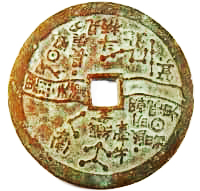
The coin has representations of celestial bodies on it including the sun, Big Dipper, Venus, and a few others. Notice the man-like stick figure constellation at the bottom. Next to its “head” is written 牽牛 qiānniú341• which signifies Altair. It is significant that Altair was included on the coin and its name written out. Altair here, instead of being the center of the typical three-star constellation, is part of a man-like constellation that, again, closely resembles the Seal Script character for 天 God from that time period. Are all of these things coincidences on top of coincidences? They can’t be.
•341 Pronounced: chēĕn·nēō.
~ ~ ~
About 37 years after the death of Jesus, in year c. 70, the Romans destroyed the Hebrew temple and left Jerusalem in ruins. Subsequent rulers continued to force Israelites from their homelands. “Jews” and “Christians” were persecuted throughout the Roman Empire, and many emigrated to foreign lands. It was not until 1948 that the State of Israel was reestablished and Jews from all over the world began returning to their ancestral homelands. That year was roughly 3780 years after the birth of Israel himself. And it has now been more than four millennia since the birth of Abraham.342 What a remarkable family heritage and history!
Jerusalem,343• the principal city of Israel, has probably seen more conflict than any other city in the world. Ironically, its name is believed to mean “hope of peace.” Maybe, someday, ירושלים Jerusalem can be called again by its original name שלם Salem, which means “Peace.”
342 אברהם Abraham (亞伯拉罕) (c. -1992 › -1817) is the patriarch of both the Israelites and Arabs.
•343 Pronounced in Hebrew: yĕ·rū·shä·lä·yīm.
Year Estimates for Hebrew Events
The year estimates for Hebrew events in this work are based on chronologies and statements found within the ancient Hebrew text itself, augmented with outside sources. No reinterpretations are made of extraordinary assertions therein, such as miraculous events, or life spans far exceeding a century.344 I am conveying the Hebrew records to you as they are written.
344 The Hebrew texts state that אדם Adam lived the years c. -4000 › -3070, שת Seth (c. -3870 › -2958), אנוש Enos (c. -3765 › -2860), קינן Cainan (c. -3675 › -2765), מהללאל Mahalaleel (c. -3605 › -2710), ירד Jared (c. -3540 › 2578), חנוך Enoch (c. -3443 › -3013), מתושלח Methuselah (c. -3313 › -2344), למך Lamech (c. -3126 › -2349), נח Noah (c. -2944 › -1994), The Great Flood was year c. -2344, שם Shem (מלכי־צדק Melchizedek) c. -2442 › -1842, ארפכשד Arphaxad (c. -2342 › -1904), שלח Salah (c. -2384 › -1951), עבר Eber (c. -2277 › -1813), פלג Peleg (c. -2243 › -2004), רעו Reu (c. -2213 › -1974), שרוג Serug (c. -2181 › -1951), נחור Nahor (c. -2151 › -2003), תרח Terah (c. -2122 › -1917), אברהם Abraham (c. -1992 › -1817), יצחק Isaac (c. -1892 › -1712), and ישראל Israel (יעקֹב Jacob) c. -1832 › -1685.
That said, I will try to resolve inconsistencies in the text when appropriate and feasible. One example is a passage that refers to the amount of time the Israelites were in Egypt:
“Now the sojourning of the children of Israel, who dwelt in Egypt, was four hundred and thirty years.”345
345 Exodus 12:40.
If this passage is understood to mean that the Hebrews sojourned in Egypt 430 years, then the other chronologies and genealogies in the same text cannot be harmonized.346 However, if this passage is understood to refer to the family of Israel and their sojourning (including Egypt), then the time issue is resolved. The Hebrew chronologies support Abraham leaving Ur for his “promised land” in Canaan 430 years before the children of Israel left Egypt. This interpretation is collaborated by other ancient documents. The same passage (Exodus 12:40) in the Septuagint, the earliest extant Greek translation of the Hebrew Bible, states:
“And the sojourning of the children of Israel, while they sojourned in the land of Egypt and the land of Canaan, was 430 years.”347
346 Genesis 46:8-12 states that לוי Levi, קהת Kohath, פלוא Phallu, and חצרון Hezron were part of ישראל Israel’s greater family that entered Egypt with him in about -1702. משה Moses, the Hebrew leader during the Egyptian exodus, was the grandson of both לוי Levi (Numbers 26:59: לוי Levi-יוכ֫בד Jochebed-משה Moses) and קהת Kohath (Exodus 6:16-20: לוי Levi-קהת Kohath-עמרם Amram-משה Moses). This is true because עמרם Amram, the grandson of לוי Levi, married יוכ֫בד Jochebed, the daughter of לוי Levi and they had משה Moses. Two contemporaries of משה Moses, דתן Dathan and אבירם Abiram, were the grandsons of פלוא Phallu (Numbers 26:7-9: ראובן Reuben-פלוא Phallu-אליאב Eliab-דתן Dathan and אבירם Abiram). And another contemporary of משה Moses, נחשון Nahshon, was the great grandson of חצרון Hezron (Ruth 4:18-20: יהודה Judah-פרץ Pharez-חצרון Hezron-רם Ram-עמינדב Amminadab-נחשון Nahshon).
347 Exodus 12:40 underlining added.
The same is found in the ancient Samaritan version of the Hebrew Bible (Samaritan Pentateuch):
“And the sojourning of the children of Israel, while they sojourned in the land of Egypt and the land of Canaan, was 430 years.”348
348 Exodus 12:40: “ומושב בני ישראל ואבתם אשר ישבו בארץ כנען ובארץ מצרים שלשים שנה וארבע מאות שנה” underlining added.
From the combined evidence, it appears that the family clan of Israel sojourned in the land of Canaan 215 years (c. -1917 › -1702), and in the land of Egypt 215 years (c. -1702 › -1487), for a total of 430 years. The next verse in all three texts adds more information:
“And it came to pass at the end of the four hundred and thirty years [of the family of Israel’s sojourn], even the selfsame day it came to pass, that all the [Israelites] went out from the land of Egypt.”349
349 Exodus 12:41 underlining added.
This passage states that Abraham departed Ur for his “promised land” on the “same day” (of the year) that the Israelites “went out from the land of Egypt.” Therefore, if the years herein are correct, we can determine that the first Passover preparations and ceremony of the Israelites took place on April 6, -1487. Then, after midnight, they left Egypt for their “promised land” under the light of the full moon on April 7, -1487.
And, according to the Hebrew text, this also means that Abraham’s travel preparations were completed on April 6, and he left Ur for his “promised land” in the darkness of the new moon on April 7, -1917 (430 years earlier). Also, on year 0, the Hebrew Passover began on April 6 while a new star appeared next to Altair in the light of the full moon on April 7, 0. All of these specific dates can be verified by the astronomical calendar.
The Hebrew, God יהוה Yahweh
As mentioned, the King James English translation of the Hebrew Bible (which is used in this work) is the most widely revered and accepted. Although the translation was a remarkable accomplishment, it was certainly not perfect (as already noted). Another layered problem with the translation is that the Hebrew God, יהוה Yahweh (YHWH), was rendered: “Jehovah.”350 Then, following the Jewish pattern of limiting the use of the deity’s name out of respect, the translators replaced יהוה Yahweh with the terms: “Lord” or “GOD.” Each substitution was acknowledged by the use of small caps or all caps. Now each time the text reads “Lord” or “GOD” in English, the original Hebrew text really had the name יהוה Yahweh.
350 “Jehovah” is a poor English translation of יהוה (YHWH).
The name, יהוה Yahweh “Jehovah,” appears nearly seven thousand times in the original Hebrew Bible, but is only found 7 times in the English King James Version. יהוה Yahweh was almost always rendered “Lord” or “GOD.” (These substitutions should not be confused with the actual terms לורד “Lord” and אלוהים “God” not in caps.) For clarity in this work, Hebrew passages containing the King James’ substitutions will be returned to the original Hebrew “יהוה.”
The Hebrew term אלוהים Elohim,351• usually translated “God” in English, is composed of לא El, which means God, וה oh which meant head, and the suffix םי im which made the term plural in Paleo-Hebrew. Later Hebrew scholars, unfortunately and incorrectly, ignored the plural designation. אלוהים Elohim in Paleo-Hebrew meant “Gods,” “Head of the Gods,” “Head God,” “God Head,” “Chief God,” or “The Head One of the Gods.” This controversial fact will not be further addressed in this work. When Hebrew passages containing אלוהים Elohim are quoted, they will be displayed as they are found in the King James Translation.
•351 Pronounced: ĕ·lō·hĭm.
There is a passage in the Hebrew text worth mentioning:
“And God spake unto Moses, and said unto him, I am יהוה God: And I appeared unto Abraham, unto יצחק Isaac, and unto Jacob, by the name of God Almighty, but by my name יהוה Yahweh was I not known to them.”352
352 Exodus 6:2-3.
This passage implies that an earlier term for the Hebrew God was “God Almighty,” which is a transliteration of the name of the Chinese God 上帝 Shàng Dì.353• This is an interesting link between 上帝天 God and יהוה God.
•353 Pronounced: shäng·dē.
(49) He was called “God Almighty.”
יהוה God and 上帝 God were both called “God Almighty.” Exodus 6:2-3
The ancient Hebrews viewed and approached God יהוה Yahweh in the same ways the ancient Chinese viewed and approached 上帝天 God Shàng Dì Tiān. The beliefs, attitudes, and practices were the same. Hebrews even called Him by the same name. The highlighted principles in the last chapter summary, used to describe the Chinese God, will now be revisited with ancient Hebrew passages that refer to יהוה Yahweh:
(1) He was their head God.
“I know that יהוהYahweh is greater than all gods:”354 “For יהוהYahweh is a great God, and a great King above all gods.”355 “I know that יהוהYahweh is great, and that our Lord is above all gods.”356 “For יהוהYahweh your God is God of gods, and Lord of lords,”357 “…for great is our God above all gods.”358 “For all the gods of the people are idols: but יהוהYahweh made the heavens.”359
354 Exodus 18:11.
355 Psalms 95:3.
356 Psalms 135:5.
357 Deuteronomy 10:17.
358 2 Chronicles 2:5.
359 1 Chronicles 16:26.
(2) He was anthropomorphic.
“God created [humankind] in his own image, in the image of God created he him;”360 “And יהוה God spake unto Moses face to face, as a man speaketh unto his friend.”361 “Nebuchadnezzar full of fury… commanded the most mighty men that were in his army to bind Shadrach, Meshach, and Abed-nego, and to cast them into the burning fiery furnace. … Nebuchadnezzar the king…said unto his counsellors, Did not we cast three men bound into the midst of the fire?… Lo, I see four men loose, walking in the midst of the fire, and they have no hurt; and the form of the fourth is like the Son of God.”362 “Now, my God, let, I beseech thee, thine eyes be open, and let thine ears be attent unto the prayer that is made in this place.”363
360 Genesis 1:27.
361 Exodus 33:11.
362 Daniel 3:19-25.
363 2 Chronicles 6:40.
(3) He gave ruling authority.
“Blessed be the name of God for ever and ever…he removeth kings, and setteth up kings:”364 “wast thou not made the head of the tribes of Israel, and יהוה God anointed thee king over Israel?”365 “…the God of heaven hath given thee a kingdom, power, and strength, and glory.”366 “And in the days of these kings shall the God of heaven set up a kingdom…it shall break in pieces and consume all these kingdoms,”367
364 Daniel 2:20-21.
365 1 Samuel 15:17.
366 Daniel 2:37.
367 Daniel 2:44.
(4) He expected rulers to be just and good.
“He that ruleth over men must be just, ruling in the fear of God.”368 “…what doth יהוה God require of thee, but to do justly, and to love mercy,”369 “he [that] sitteth upon the throne of his kingdom…shall…fear יהוה Yahweh his God, to keep all the words of this law and these statutes, to do them…that he may prolong his days in his kingdom, he, and his children, in the midst of Israel.”370
368 2 Samuel 23:3.
369 Micah 6:8.
370 Deuteronomy 17:18-20.
(5) He gave commandments.
“And now, Israel, what doth יהוה Yahweh thy God require of thee, but to…keep the commandments of יהוה God, and his statutes,”371 “Thou shalt therefore keep the commandments, and the statutes, and the judgments, which I command thee this day, to do them.”372 “[יהוה Yahweh] sendeth forth his commandments upon earth:”373
371 Deuteronomy 10: 12-13.
372 Deuteronomy 7:11.
373 Psalms 147:15.
(6) He communicated through dreams.
“In Gibeon יהוה God appeared to Solomon in a dream by night: and God said…”374 “But God came to Abimelech in a dream by night, and said to him…”375 “And God came to Laban the Syrian in a dream by night, and said unto him…”376
374 1 Kings 3:5.
375 Genesis 20:3.
376 Genesis 31:24.
(7) He sent punishments upon the wicked.
“And the children of Israel did evil again in the sight of יהוה God; and יהוה God delivered them into the hand of the Philistines forty years.”377 “Upon the wicked he shall rain snares,”378 “And I [יהוה God] will punish the world for their evil, and the wicked for their iniquity;”379
377 Judges 13:1.
378 Psalms 11:6.
379 Isaiah 13:11.
(8) He gave gifts of strength to worthy persons.
“יהוה God will give strength unto his people;”380 “God is my strength and power: and he maketh my way perfect.”381 “It is God that girdeth me with strength,”382 “Wait on יהוה God: be of good courage, and he shall strengthen thine heart:”383 “But they that wait upon יהוה God shall renew their strength; they shall mount up with wings as eagles; they shall run, and not be weary; and they shall walk, and not faint.”384
380 Psalms 29:11.
381 2 Samuel 22:33.
382 Psalms 18:32.
383 Psalms 27:14.
384 Isaiah 40:31.
(9) He strengthened and helped worthy armies.
“Hear, O Israel, ye approach this day unto battle against your enemies: let not your hearts faint, fear not, and do not tremble, neither be ye terrified because of them; For יהוה Yahweh your God is he that goeth with you, to fight for you against your enemies, to save you.”385 “Ye shall not fear [the opposition forces]: for יהוה Yahweh your God he shall fight for you.”386 “our God shall fight for us.”387
385 Deuteronomy 20:3-4.
386 Deuteronomy 3:22.
387 Nehemiah 4:20.
(10) He helped the opposition of corrupt rulers.
“And the children of Israel did evil again in the sight of יהוה God; and יהוה God delivered them into the hand of the Philistines forty years.”388 “And the children of Israel did evil in the sight of יהוה God: and יהוה God delivered them into the hand of Midian seven years. And the hand of Midian prevailed against Israel:”389
388 Judges 13:1.
389 Judges 6:1-2.
(11) He rewarded worthy individuals.
“And יהוה God appeared unto [Abraham], and said…I will make thy seed to multiply as the stars of heaven, and will give unto thy seed all these countries; and in thy seed shall all the nations of the earth be blessed; Because that Abraham obeyed my voice, and kept my charge, my commandments, my statutes, and my laws.”390 “And Abraham was old, and well stricken in age: and יהוה God had blessed Abraham in all things.”391
390 Genesis 26:2-5.
391 Genesis 24:1.
(12) He created the heavens.
“…יהוה God that created the heavens;”392 “I [יהוה God] have made the earth, and created man upon it: I, even my hands, have stretched out the heavens,”393 “By the word of יהוה God were the heavens made;”394 “…God created the heaven and the earth.”395 “Thus saith יהוהGod, he that created the heavens, and stretched them out;”396 “Ah Lord יהוה God! behold, thou hast made the heaven and the earth by thy great power and stretched out arm,”397
392 Isaiah 45:18.
393 Isaiah 45:12.
394 Psalms 33:6.
395 Genesis 1:1.
396 Isaiah 42:5.
397 Jeremiah 32:17.
(13) He created the earth. “I [יהוה God] have made the earth, and created man upon it: I, even my hands, have stretched out the heavens,”398 “יהוה God… thou hadst formed the earth and the world,”399 “Thus saith יהוה God, he that created the heavens, and stretched them out; he that spread forth the earth, and that which cometh out of it;”400
398 Isaiah 45:12.
399 Psalms 90:1-2.
400 Isaiah 42:5.
(14) He created human beings.
“God created [humankind] in his own image, in the image of God created he him; male and female created he them.”401 “And יהוה God planted a garden eastward in Eden; and there he put the man whom he had formed.”402 “God created man upon the earth,”403 “I [יהוה God] have made the earth, and created man upon it:”404
401 Genesis 1:27.
402 Genesis 2:8.
403 Deuteronomy 4:32.
404 Isaiah 45:12.
(15) He created everything.
“יהוה God hath made all things…”405 “The great God that formed all things…”406 “…our God, …all things come of thee,”407 “O יהוה Yahweh our God…thou hast made all these things.”408 “In the beginning God created the heaven and the earth…And God said, Let the earth bring forth grass, the herb yielding seed, and the fruit tree yielding fruit after his kind…And God made two great lights; the greater light to rule the day, and the lesser light to rule the night: he made the stars also.”409
405 Proverbs 16:4.
406 Proverbs 26:10.
407 1 Chronicles 29:13-14.
408 Jeremiah 14:22.
409 Genesis 1:1-16.
(16) He dwelt in heaven.
“But our God is in the heavens:”410 “O יהוה Yahweh my God…hear thou in heaven thy dwelling place:”411 “Let us lift up our heart with our hands unto God in the heavens.”412 “O יהוה God…hear thou from thy dwelling place, even from heaven;”413 “יהוה God looketh from heaven;”414
410 Psalms 115:3.
411 1 Kings 8:28-30.
412 Lamentations 3:41.
413 2 Chronicles 6:19-21.
414 Psalms 33:13.
(17) He controlled the weather.
“He giveth snow…he causeth his wind to blow, and the waters to flow.”415 “…יהוה God sent thunder and hail, …and יהוה God rained hail upon the land of Egypt.”416 “And יהוה God turned a mighty strong west wind, which took away the locusts, and cast them into the Red sea;”417
415 Psalms 147:16-18.
416 Exodus 9:23.
417 Exodus 10:19.
(18) He sent rain.
“Sing unto יהוה God with thanksgiving…Who covereth the heaven with clouds, who prepareth rain for the earth,”418 “for יהוה God had not caused it to rain upon the earth,”419 “Then I [יהוה God] will give you rain in due season,”420 “For yet seven days, and I [יהוה God] will cause it to rain upon the earth…”421
418 Psalms 147:7-8.
419 Genesis 2:5.
420 Leviticus 26:4.
421 Genesis 7:4.
(19) He gave abundant harvests.
“Then I [יהוה God] will give you rain in due season, and the land shall yield her increase, and the trees of the field shall yield their fruit.”422 “God give thee of the dew of heaven, and the fatness of the earth, and plenty of corn and wine:”423 “And I [יהוה God] will rebuke the devourer for your sakes, and he shall not destroy the fruits of your ground; neither shall your vine cast her fruit before the time in the field, saith יהוה God of hosts.”424
422 Leviticus 26:4.
423 Genesis 27:28.
424 Malachi 3:11.
(20) He sent famines.
“for יהוה God hath called for a famine; and it shall also come upon the land seven years.”425 “And then יהוה God’s wrath be kindled against you, and he shut up the heaven, that there be no rain, and that the land yield not her fruit;”426 “God hath shewed Pharaoh what he is about to do…Behold, there come seven years of great plenty throughout all the land of Egypt: And there shall arise after them seven years of famine.”427
425 2 Kings 8:1.
426 Deuteronomy 11:17.
427 Genesis 41:25-30.
(21) He gave omens by celestial events.
“God said, Let there be lights in the firmament of the heaven…and let them be for signs,”428 “and he worketh signs and wonders in heaven…”429 “And I [יהוה God] will shew wonders in the heavens and in the earth, blood, and fire, and pillars of smoke. The sun shall be turned into darkness, and the moon into blood, before the great and the terrible day of יהוה God come.”430
428 Genesis 1:14.
429 Daniel 6:27.
430 Joel 2:30-31.
(22) He was omniscient.
“for יהוה God searcheth all hearts, and understandeth all…”431 “Great is our Lord [יהוה God], and of great power: his understanding is infinite.”432 “the wondrous works of him which is perfect in knowledge…”433 “יהוה God of gods, יהוה God of gods, he knoweth,”434 “Shall not God search this out? for he knoweth the secrets of the heart.”435
431 1 Chronicles 28:9.
432 Psalms 147:5.
433 Job 37:16.
434 Joshua 22:22.
435 Psalms 44:21.
(23) He could discern all.
“The eyes of יהוה God are in every place, beholding the evil and the good.”436 “the Great, the Mighty God, יהוה God of hosts, is his name, Great in counsel, and mighty in work: for thine eyes are open upon all the ways of the sons of men:”437 “יהוה God searcheth all hearts, and understandeth all the imaginations of the thoughts:”438 “for thou only knowest the hearts of the children of men:”439
436 Proverbs 15:3.
437 Jeremiah 32:18-19.
438 1 Chronicles 28:9.
439 2 Chronicles 6:30.
(24) He was perfect.
“As for God, his way is perfect:”440 “the wondrous works of him which is perfect in knowledge…”441 “the law of יהוה God is perfect,”442 “He is the Rock, his work is perfect:”443 “It is God that…maketh my way perfect.”444 “Thou shalt be perfect with יהוה Yahweh thy God.”445
440 2 Samuel 22:31. See also Psalms 18:30.
441 Job 37:16.
442 Psalms 19:7.
443 Deuteronomy 32:4.
444 Psalms 18:32.
445 Deuteronomy 18:13.
(25) He was all-powerful.
“Ah Lord יהוה God! behold, thou hast made the heaven and the earth by thy great power and stretched out arm, and there is nothing too hard for thee.”446 “…יהוה God …I know that thou canst do every thing,”447 “יהוה God appeared to Abram, and said unto him, I am the Almighty God;”448 “I am God Almighty:”449
446 Jeremiah 32:17.
447 Job 42:1-2.
448 Genesis 17:1.
449 Genesis 35:11.
(26) He was eternal.
“The eternal God is thy refuge,”450 “Thou art the same, and thy years shall have no end.”451 “from everlasting to everlasting thou art God.”452 “I blessed the most High [יהוה God], and I praised and honoured him that liveth for ever, whose dominion is an everlasting dominion,”453
450 Deuteronomy 33:27.
451 Psalms 102:27.
452 Psalms 90:2.
453 Daniel 4:34.
(27) He was good.
“יהוה God is gracious, and full of compassion; slow to anger, and of great mercy. יהוה God is good to all: and his tender mercies are over all his works.”454 “O give thanks unto יהוה God; for he is good:”455 “יהוה God, merciful and gracious, longsuffering, and abundant in goodness and truth,”456
454 Psalms 145:8-9.
455 Psalms 136:1 and 118:29.
456 Exodus 34:6.
(28) He was kind.
“O יהוה God …How excellent is thy lovingkindness,”457 “Have mercy upon me, O God, according to thy lovingkindness: according unto the multitude of thy tender mercies…”458 “with everlasting kindness will I have mercy on thee, saith יהוה God thy Redeemer.”459
457 Psalms 36:6-7.
458 Psalms 51:1.
459 Isaiah 54:8.
(29) He was merciful.
“Great are thy tender mercies, O יהוה God:”460 “O give thanks unto יהוה God; for he is good: for his mercy endureth for ever.”461 “Have mercy upon me, O God, according to thy lovingkindness: according unto the multitude of thy tender mercies blot out my transgressions.”462 “It is of יהוה God’s mercies that we are not consumed, because his compassions fail not.”463
460 Psalms 119:156.
461 Psalms 136:1; 118:29.
462 Psalms 51:1.
463 Lamentations 3:22.
(30) He was compassionate.
“But thou, O Lord, art a God full of compassion, and gracious, longsuffering, and plenteous in mercy and truth.”464 “יהוה God is gracious, and full of compassion; slow to anger, and of great mercy.”465 “יהוה God was gracious unto them, and had compassion on them,”466 “יהוה Yahweh thy God will…have compassion upon thee,”467
464 Psalms 86:15.
465 Psalms 145:8.
466 2 Kings 13:23.
467 Deuteronomy 30:3.
(31) He was impartial.
“for there is no iniquity with יהוה Yahweh our God, nor [partiality] of persons, nor taking of [bribes].”468 “neither doth God respect [more than another] any person:”469 “And יהוה God said unto Cain, Why art thou wroth? and why is thy countenance fallen? If thou doest well, shalt thou not be accepted? and if thou doest not well, sin lieth at the door.”470
468 2 Chronicles 19:7.
469 2 Samuel 14:14.
470 Genesis 4:6-7.
(32) He was loving.
“I have loved you, saith יהוה God.”471 “but יהוה Yahweh thy God turned the curse into a blessing unto thee, because יהוה Yahweh thy God loved thee.”472 “O יהוה God…How excellent is thy lovingkindness,”473 “But because יהוה God loved you,”474 “יהוה God had a delight in thy fathers to love them,”475
471 Malachi 1:2.
472 Deuteronomy 23:5.
473 Psalms 36:6-7.
474 Deuteronomy 7:8.
475 Deuteronomy 10:15.
(33) He gave gifts of courage and strength.
“Oh thou God of my fathers, who hast given me wisdom and might,”476 “Wait on יהוה God: be of good courage, and he shall strengthen thine heart:”477 “Be strong and of a good courage; be not afraid, neither be thou dismayed: for יהוה Yahweh thy God is with thee whithersoever thou goest.”478
476 Daniel 2:23.
477 Psalms 27:14.
478 Joshua 1:9.
(34) He gave gifts of judgment.
“and judgment was given to the saints of the most High;”479 “O יהוה God …Teach me good judgment and knowledge:”480 “…every man’s judgment cometh from יהוה God.”481 “But truly I am full of power by the spirit of יהוה God, and of judgment, and of might,”482 “יהוה God … hath filled Zion with judgment and righteousness.”483
479 Daniel 7:22.
480 Psalms 119:65-66.
481 Proverbs 29:26.
482 Micah 3:8.
483 Isaiah 33:5.
(35) He gave gifts of wisdom.
“And Moses called Bezaleel and Aholiab, and every wise hearted man, in whose heart יהוה God had put wisdom,”484 “I [יהוה God] have given thee a wise and an understanding heart;”485 “For יהוה God giveth wisdom…”486
484 Exodus 36:2.
485 1 Kings 3:12.
486 Proverbs 2:6.
(36) He enlightened human beings.
“יהוה Yahweh my God will enlighten my darkness.”487 “…thy words giveth light; it giveth understanding…”488 “the commandment of יהוה God is pure, enlightening the eyes.”489 “Thy word is a lamp unto my feet, and a light unto my path.”490 “let us walk in the light of יהוה God.”491 “יהוה God is my light…”492
487 Psalms 18:28.
488 Psalms 119:130.
489 Psalms 19:8.
490 Psalms 119:105.
491 Isaiah 2:5.
492 Psalms 27:1.
(37) He protected human beings.
“O love יהוה God, all ye his saints: for יהוה God preserveth the faithful,”493 “יהוה God preserveth all them that love him:”494 “Wherefore ye shall do my statutes, and keep my judgments, and do them; and ye shall dwell in the land in safety.”495 “יהוה God is my rock, and my fortress, and my deliverer;”496
493 Psalms 31:23.
494 Psalms 145:20.
495 Leviticus 25:18.
496 2 Samuel 22:2.
(38) He gave human beings peace.
“God יהוה Yahweh… will speak peace unto…his saints:”497 “יהוה God will bless his people with peace.”498 “And יהוה God spake unto Moses, saying…Behold, I give unto him my covenant of peace:”499 “יהוה God, thou wilt ordain peace for us:”500 “Thou wilt keep him in perfect peace,”501
497 Psalms 85:8.
498 Psalms 29:11.
499 Numbers 25:10-12.
501 Isaiah 26:12.
502 Isaiah 26:3.
(39) He gave human beings prosperity.
“because יהוה God was with him, and that which he did, יהוה God made it to prosper.”503 “יהוה God hath prospered my way;”504 “And יהוה God was with him; and he prospered whithersoever he went…”505 “And יהוה God was with Joseph, and he was a prosperous man;…And his master saw that יהוה God was with him, and that יהוה God made all that he did to prosper in his hand.”506
503 Genesis 39:23.
504 Genesis 24:56.
505 2 Kings 18:7.
506 Genesis 39:2-3.
(40) He lengthened the lives of the good.
“That thou mightest fear יהוה Yahweh thy God, to keep all his statutes and his commandments, …that thy days may be prolonged.”507 “Honour thy father and thy mother: that thy days may be long upon the land which יהוה Yahweh thy God giveth thee.”508
507 Deuteronomy 6:2.
508 Exodus 20:12.
(41) He gave human beings joy.
“God had made them rejoice with great joy:”509 “Thou wilt shew me the path of life: in thy presence is fullness of joy; at thy right hand there are pleasures for evermore.”510 “for יהוה God had made them joyful,”511 “whoso trusteth in יהוה God, happy is he.”512
509 Nehemiah 12:43.
510 Psalms 16:11.
511 Ezra 6:22.
512 Proverbs 16:20.
(42) He created the good in human beings.
“And God said, Let us make man in our image, after our likeness:…So God created [humankind] in his own image, in the image of God created he him; male and female created he them…And God saw every thing that he had made, and, behold, it was very good.”513
513 Genesis 1:26-31.
(43) He was honored.
“Bless יהוה God, O my soul. O יהוה Yahweh my God, thou art very great; thou art clothed with honour and majesty.”514 “Honour יהוה God…”515 “I blessed the most High [יהוה God], and I praised and honoured him that liveth for ever,”516 “Therefore God… Let people serve thee and nations bow down to thee:”517
514 Psalms 104:1.
515 Proverbs 3:9.
516 Daniel 4:34.
517 Genesis 27:28-29.
(44) He was respected (“feared”).
“יהוה God said unto me, Gather me the people together, and I will make them hear my words, that they may learn to fear [(respect)] me…”518 “the people feared יהוה God, and believed יהוה God, and his servant Moses.”519 “The fear of יהוה God is the instruction of wisdom;”520
518 Deuteronomy 4:10.
519 Exodus 14:31.
520 Proverbs 15:33.
(45) He was worshiped.
“Give unto יהוה God the glory due unto his name: bring an offering, and come before him: worship יהוה God in the beauty of holiness.”521 “choose you this day whom ye will serve…but as for me and my house, we will serve יהוה God.”522 “And I bowed down my head, and worshipped יהוה God, and blessed יהוה God…”523
521 1 Chronicles 16:29.
522 Joshua 24:15.
523 Genesis 24:48.
(46) He was worshiped via prayer. (47) He was petitioned via prayer.
“Hear my prayer, O God; give ear to the words of my mouth.”524 “Give ear to my prayer, O God; and hide not thyself from my supplication.”525 “So Abraham prayed unto God:”526 “I am the woman that stood by thee here, praying unto יהוה God. For this child I prayed; and יהוה God hath given me my petition which I asked of him:”527
524 Psalms 54:2.
525 Psalms 55:1.
526 Genesis 20:17.
527 1 Samuel 1:26-27.
(48) He was worshiped via sacrificial offerings.
“And Hezekiah commanded to offer the burnt offering upon the altar. And when the burnt offering began, the song of יהוה God began…And all the congregation worshipped…until the burnt offering was finished. And when they had made an end of offering, the king and all that were present with him bowed themselves, and worshipped.”528
528 2 Chronicles 29:27-29.
(49) He was called “God Almighty.”
“And God spake unto Moses, and said unto him, I am יהוה God: And I appeared unto Abraham, unto Isaac, and unto Jacob, by the name of God Almighty,”529
529 Exodus 6:2-3.
The entire book is available in print form HERE.
Subsequent book sections include:
Chinese Sacrifices
The Border Sacrifice
Sacrificial Animals
Ceremonial Robes and Caps
Ancestor Veneration
Food, Grain, and Wine Offerings
Hebrew Sacrifices
Why Did the Chinese Offer Sacrifices?
Spirits (神)
Revelations and Messengers from God
Blood Consecration
Why Did the Hebrews Offer Sacrifices?
Chinese History and Culture
Fuxi (伏羲) – Nüwa (女媧/娲) │ Adam (אדם) – Eve (איב)
The Chinese Great Yü (大禹) │ Hebrew Noah (נח)
Changes to the Ancient Order
Confucius (孔夫子)
The Chinese Passover
The Blood of the Sacrifice
Feast of Unleavened Bread (חג המצות/無酵節/无酵节)
Passover New Year (過/过年) Ceremony
Adoption of Hebrew Ceremonies in China
Lost Tribes of Israel in Ancient China
Levites (לויים) in West China
Hebrew Shu (蜀) Scenario Played Out
Lost Tribes of Israel in Asia
Hebrew New Year, Not Chinese New Year
Japan and Korea’s Israelite Heritage
The Hata (秦) People
The Buyeo (부여/夫餘/余)
The Yamato (大和)
The Paleo-Hebrew Roots of the Yamato Language
Shintoism (神道)
Korea’s Israelite Heritage
The Hebrew Language in Asia
Ming (明) Dynasty Ancient Order Restoration Attempt
Temple of Heaven = Altar of God (天壇/天坛)
The Border Sacrifice Ceremony
Similar Hebrew History and Culture
…

