
https://christianhistoryinstitute.org/magazine/article/ch156-thomas-in-china
Did Thomas evangelize China?


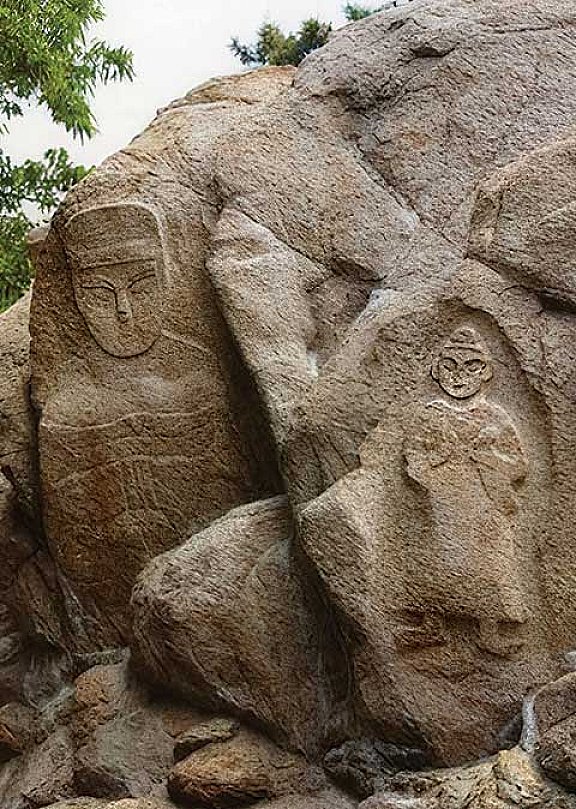
(ABOVE: Kongwangshan sculptures—Quizlet.com)
Some recent publications assert that Thomas not only evangelized in India but also as far east as ancient China. These claims cite a Syro-Malabar (eastern Catholic tradition rooted in the Malabar Coast of India) liturgical prayer that remembers Thomas, through whom “the Chinese and the Ethiopians were converted to the truth.”
- 「聖トマスを通じて、偶像崇拝の誤謬はインドから消え去った」
- 「聖トマスを通じて、中国人とエチオピア人は真理へと回帰した」
- 「聖トマスを通じて、天の王国は翼を得て中国へと昇っていった」 [1]
- キルヒャーは『中国図説』の中で、キリストの十二使徒の一人である聖トマスが、最初のインド伝道者としてアジア、そして中国(カタイ)にまで赴き福音を伝えたというキリスト教の伝統的な歴史観(聖トマス伝承)を展開しています。 [1, 2]
- これは、キリスト教が17世紀のイエズス会宣教師(マテオ・リッチら)によって初めてもたらされたのではなく、古代にすでにアジアへ到達していたことを歴史的に裏付けるための重要な論拠とされました。 [1, 2]
- 東方への宣教伝承: 初期キリスト教の伝承において、使徒トマスはイエスの復活後に東方へと旅立ち、インドにキリスト教をもたらした(のちにチェンナイ近郊のマイラプールで殉教した)とされています。
- 奇跡の十字架: キルヒャーは『中国図説』の中で、マイラプールで発見されたという、古い文字(パフラヴィー文字)が刻まれた石の十字架を紹介しました。これは「トマス・クロス」とも呼ばれ、使徒トマスがインドに福音をもたらした証拠として、当時のヨーロッパのキリスト教世界で非常に重視されました。
 [10/19まで] アカウント連携でdポイント最大20%還元+抽選で最大10万ポイントが当たる アカウントを連携する
 Recently a few Christian authors have picked up on this prayer and made it part of their arguments for an early Christian presence in China.
Two such proponents of Thomas visiting China are Wang Weifan, a Chinese seminary professor, and Pierre Perrier, a Catholic layman from France. The latter has gone so far as to give a precise chronology of Thomas’s visit to China, claiming that in AD 64 he traveled up the Yellow River from Lianyungang via Xuzhou and Kaifeng to Luoyang, where he founded a church in 68 before returning to India and martyrdom in 72.
THE EVIDENCE?
These authors base their theory on rock carvings on Kongwang, a mountain in Lianyungang, which they date to the first century and interpret as images of Thomas, the Virgin Mary, and the Chi-Rho symbol; Han Dynasty tomb carvings in Xuzhou that purportedly show biblical stories as well as a Passover lamb and the Christian fish symbol; a claim that the medieval Jewish community in Kaifeng actually goes back to the early Christian period; and reinterpreting the history of the Buddhist White Horse Monastery in Luoyang, which they see as originally a Christian church founded by Thomas.
However, these claims have no basis in fact. The Lianyungang carvings may date to the first century, but they are generic Chinese figures, and no Chi-Rho symbol is to be found. This Greek abbreviation would have been meaningless to Semitic-speakers like Thomas! The Han-era tombs of Xuzhou have typical Chinese decorations of the period with nothing to indicate Christian influence. Furthermore the Jewish community in Kaifeng was founded only in the tenth or eleventh century. And, finally, no evidence exists that the White Horse Monastery in Luoyang was ever anything other than a Buddhist temple. The truth is that we have no evidence of a Christian mission to China in the earliest centuries.
EXCHANGING AND EVANGELIZING
Both overland and maritime trade did exist between China and the West in Roman times. Yet this trade was segmented: Romans and Arabs sailed as far as India; Indians or Malaysians took the goods from there inland, or farther across the Bay of Bengal to Malaysia; Malay or Chinese traders then took the products to the ports along the South China Sea, and then inland. The overland route was just as compartmentalized. Chinese goods were passed on to Kushans (in modern Afghanistan), who sold them to Parthians and Arabs, who in turn passed them on to merchants from the Roman Empire. As far as we know, virtually no traders went continuously from the Mediterranean to China.
Generation by generation Christians did spread the gospel eastward, and individual Christians may have penetrated China. We have no evidence, however, of a Christian church in China in the first five centuries. Rather, Christianity’s entrance into China was an extension of the larger picture of Christianity’s slow permeation of Mesopotamia and Central Asia via the areas along the Silk Road.
By Glen L. Thompson
[Christian History originally published this article in Christian History Issue #156.0 in 2025]
Glen L. Thompson, retired professor emeritus of church history at Asia Lutheran Seminary and author of Jingjiao: The Earliest Christian Church in Chinaトーマスは中国で布教活動を行ったのか?
(上: 孔王山の彫刻 — Quizlet.com)
近年の出版物の中には、トマスはインドだけでなく、東は古代中国にまで福音を伝えたと主張するものがある。これらの主張は、Syro-Malabar シロ・マラバル教会(インドのマラバル海岸にルーツを持つ東方カトリック教会)の典礼祈祷文を引用しており、その中でトマスは「中国人とエチオピア人が真理に改宗した」と記されている。
最近、数人のキリスト教著述家がこの祈りを取り上げ、中国における初期キリスト教の存在を主張する論拠の一つとして用いている。
トマスが中国を訪れたという説を支持する人物として、中国の神学校教授である王維凡氏と、フランス出身のカトリック信徒であるピエール・ペリエ氏が挙げられます。ペリエ氏は、トマスの中国訪問について詳細な年代記を提示しており、西暦64年に連雲港から黄河を遡り、徐州、開封を経て洛陽に至り、68年に教会を設立した後、72年にインドに戻り殉教したと主張しています。
証拠は?
これらの著者は、連雲港の孔王山にある岩絵を根拠に、その理論を構築している。彼らは岩絵を1世紀のものとし、トマス、聖母マリア、キリストのモノグラム(カイロー)のシンボルと解釈している。また、徐州にある漢王朝時代の墓の彫刻には、聖書の物語や過越祭の子羊、キリスト教の魚のシンボルが描かれているとされている。さらに、開封の中世ユダヤ人コミュニティは実際には初期キリスト教時代にまで遡ると主張し、洛陽にある仏教の白馬寺の歴史を再解釈し、そこは元々はトマスによって設立されたキリスト教の教会だったとしている。
しかし、これらの主張には事実に基づいた根拠がありません。連雲港の彫刻は1世紀のものかもしれませんが、それらは一般的な中国の図像であり、キリストのモノグラム(カイロー)のシンボルは見当たりません。このギリシャ語の略語は、トーマスのようなセム語話者にとって意味不明だったでしょう。徐州の漢代の墓には、当時の典型的な中国の装飾が施されており、キリスト教の影響を示すものは何もありません。さらに、開封のユダヤ人コミュニティは10世紀か11世紀になって初めて設立されました。そして最後に、洛陽の白馬寺が仏教寺院以外の何物でもなかったという証拠は存在しません。真実は、初期の数世紀にキリスト教の宣教が中国に行われたという証拠は全くないということです。
交流と伝道
ローマ時代には、中国と西欧の間には陸路と海路の両方の貿易が存在していた。しかし、この貿易は分断されていた。ローマ人やアラブ人はインドまで航海し、インド人やマレーシア人はそこから商品を内陸部、あるいはベンガル湾を越えてマレーシアまで運んだ。その後、マレー人や中国人の商人が商品を南シナ海沿岸の港まで運び、そこから内陸部へと運んだ。陸路も同様に細分化されていた。中国の商品はクシャーナ朝(現在のアフガニスタン)に渡され、クシャーナ朝はそれをパルティア人やアラブ人に売り、パルティア人やアラブ人はそれをローマ帝国の商人に渡した。我々の知る限り、地中海から中国へ途切れることなく航行する商人はほとんどいなかった。
世代を経るごとにキリスト教徒は福音を東方へと広め、個々のキリスト教徒が中国にまで進出した可能性はある。しかし、最初の5世紀に中国にキリスト教会が存在したという証拠はない。むしろ、キリスト教の中国への伝来は、シルクロード沿いの地域を経由してメソポタミアや中央アジアにキリスト教がゆっくりと浸透していったという、より大きな流れの一部であったと言えるだろう。
グレン・L・トンプソン著
[この記事は元々、Christian History誌の2025年発行第156.0号に掲載されたものです]
グレン・L・トンプソンは、アジア・ルーテル神学校の教会史名誉教授であり、『京教:中国最古のキリスト教会』の著者である。


0 件のコメント:
コメントを投稿